The post How to Use Buffer to Automate Your Job Search appeared first on Brazen Life.
]]> You know Buffer helps you manage social networks by providing a way to schedule posts to Twitter and Facebook. It allows you to be more productive, spend less time on social media and get improved results and engagement.But what about using it for your job search? Looking for a new job can be time-consuming, but using Buffer to automate part of your job search can be powerful, allowing you to increase your chances of landing a job while decreasing time spent searching.
Here are five steps to using Buffer to automate your job search.
Use Twitter’s search functions to locate potential customers for your target employer. For example, let’s say you wanted to work for Crocs. You could enter the terms “shoe recommendation” or “*can someone* crocs.”
That search is a good baseline of potential customers. Craft a tweet in Buffer. An example would be “@potentialcustomer You should check out @Crocs Yukon Flips. I have a pair and they’re amazing.”
Crocs will surely notice you’re already helping them sell and you’re not on the payroll. You show you can sell socially. Plus, you can leverage this action into further scaling your pursuit to work for them.
Those introductions add value. Spend some time coming up with potential people in your network you could introduce to each other. Of course, you’d want to get permission from both sides through email. Twitter is more informal, and an introduction on the platform between parties is a widely accepted practice.
An example could be this: Your target employer is Storefront. You have some ideas on how they can work with Etsy or Shopify to make more money. Use Buffer to schedule this tweet, “@storefront You guys are awesome! You should connect with @marketingguy for @Etsy. I can see amazing things from this.”
Boom. A connection is made. Most likely these people or companies will thank you and interact with each other. There may be gold for those companies based on your introduction.
They’ll remember you for that. That gives you value because it’s a sign that if you worked for one of those companies, you have the savviness for business development and can help grow their business through ideas and partnerships. (Click here to tweet this thought.)
Let’s say that your target employer was a company such as Breather (on demand relaxation spaces). Go through some pain spotting and write your ideas on your blog. You could write a blog post titled “3 Challenges that Breather May Have & How I Would Tackle Them.”
Start the blog post on a positive note and iterate everything the company is doing well and the reasons why you’re so bullish on their business. Then get into your pain spotting and talk about the challenges they may have and your solutions and ideas for them.
Use Buffer to schedule a tweet that looks something like this: “Will @Breather take over the world? My crazy analysis and ideas for them. (link here)”
Breather will most likely read your blog post and others in your network will share it. You can springboard this into further talks with them. Of course, this can be done for virtually any aspect of a business from sales or marketing to technical parts (like programming) of their operation.
This can be accomplished by either answering existing questions about a target employer on Quora or creating smart questions specific to a company. For example, you could ask, “What are three tactics that Otterbox should use to grow sales in North America?”
From this question, you can use that answer to give you further insight into a company. Oftentimes, you can get company employees or others in the industry to provide answers. You can use this as intelligence for future correspondence. Finally, you provide answers to the question you asked and use Buffer to schedule those on Twitter.
If one of your friends or Twitter connections is an amazing graphic designer, you can introduce him/her to someone who needs his/her services. Use Buffer to schedule these tweets to save time. Each day look for three people in your network who you may be able to help.
Over time, those people will begin retweeting your posts and introduce you to others in your network. These recommendations can get you hired or give you new freelance opportunities you may not have received previously.
By implementing these steps, you can take an advanced approach to your job search through automation and creativity. This saves time, makes you more productive and illustrates impressive skills to potential employers.
Scott Balster is founder of EmployTown and specializes in helping job seekers connect creatively with awesome employers.
Get our best career advice delivered to your inbox. Sign up today!
The post How to Use Buffer to Automate Your Job Search appeared first on Brazen Life.
]]> http://blog.brazencareerist.com/2014/09/24/use-buffer-automate-job-search/feed/ 0The post How to Make Yourself an Irresistible Job Candidate for Your Dream Company appeared first on Brazen Life.
]]> If you’re ambitious and passionate about your career, chances are you probably have a dream company you’d do anything to be a part of. Whether you’re on the job hunt, working in sales or a startup founder, you probably have one or two companies in mind you’re dying to talk to.The following steps are some of the methods I’ve used to successfully develop relationships with companies in each of those roles.
This is perhaps the most “obvious” way to get your foot in the door, but it’s still worth mentioning. Do you know anyone who works at your dream company or who used to work there? If you don’t, tackle this like a research project. LinkedIn is a great place to start.
Invite people to coffee. Buy them lunch. Get to know them. Tell them you’d love to learn more about their company. Show interest in their specific role in the company. And stay in touch!
A word to the wise: Remember networking should never be rushed. (Click here to tweet this quote.) Let people truly get to know you before you ask them to vouch for you. Trust me. The better they know you, the harder they’ll fight for you!
Above all, don’t look at people as a tool for your own devices and don’t view any specific meeting as a do-or-die conversation. Think of each person you meet as a long-term companion on the journey called your career.
If you work in business, you probably meet new people all the time. No matter the context or purpose of these meetings, always keep your dream company at the top of your mind. When people in your network ask if there’s anything they can do to help you, see if they have any connections to your dream company.
Make it your number one (and potentially only) thing you ask for. Chances are eventually someone will be able to give you an “in.”
Do everything you can to learn how your dream company operates. Talk to people who work there. Set up a Google alert so you’re notified every time the company is in the news. Read the company blog and follow them on social media.
Figure out their hiring process. Do they tend to hire friends of current employees? Sounds like it’s time to make some internal friends. Do they use an external hiring agency to screen candidates? Find out the name of the agency and introduce yourself.
If you’re approaching the company from a sales or entrepreneurial perspective, figure out who the decision makers are within the company. Those are the people you really need to meet.
Chances are your dream company is a great place to work, which means that job openings might be few and far between. Just because they haven’t recently posted job openings on their site doesn’t mean they don’t need extra help — especially if the company is a startup or an early-stage company.
It sounds non-traditional, but in these cases you should consider volunteering for the company. Do some free writing. Show them how they can cut down their spending. Talk them up on social media. Offer them discounts, free trials or free work on your end. Figure out their needs and find a way to add value.
Give, give, give. Be open about the fact that you’d love to work there one day. When a job does open, companies are likely to hire someone whose work they already know and love.
How did other people get into the company? Are they hired out of a particular Masters program? Consider going back to school for a year or two to better position yourself.
Do they tend to recruit employees from one of their competitors? You should consider working for that competitor.
Does your dream company tend to hire employees based on years of experience and rigid requirements? Or are they more concerned about the quality of accomplishments and personality of candidates? Figure out who and how current employees were hired, then find a way to put yourself in the most “hirable” position.
Above all, when you’re trying to get your foot in the door of any company, remember that good things take time. Landing your dream job can take months or even years. Get to know people within the company. Build your reputation by being a star employee in your current job. And above all, develop an expertise and skill set that will make you a valuable asset to any company. I guarantee your dream company is looking an especially valuable employee — You.
Jody Porowski is the founder and CEO of Avelist, an online platform where you can find advice from friends and experts. Follow her on Twitter @jodyporowski and read more about her entrepreneurial journey at jodyporowski.com.
Get our best career advice delivered to your inbox. Sign up today!
The post How to Make Yourself an Irresistible Job Candidate for Your Dream Company appeared first on Brazen Life.
]]> http://blog.brazencareerist.com/2014/09/23/make-irresistible-job-candidate-dream-company/feed/ 0The post Nonprofit Jobs: How New Grads Can Get Hired in This Fast-Growing Industry appeared first on Brazen Life.
]]> This is it, Class of 2014. You’ve earned your diploma and walked away from college with your head held high, entertaining thoughts of moving to a big city and finding your dream job. But as the reality of the post-graduate job market sets in, you might find yourself becoming impatient and discouraged, especially after two months of diligently searching for a position that puts your degree to use and coming up empty.The post-graduate job market can be frustrating, leading to one dead end after another. It’s unsettling that unemployment affects 8.5 percent of college graduates between ages 21 and 25, which is much higher than the national average. It’s even more unsettling that 44 percent of your peers are employed in a position that does not require a degree. (Click here to tweet this statistic.) What was the point of getting one if it’s not going to be of any use?
Enough with the doom and gloom, because there is hope – in a place you may not have even considered. Graduates often overlook this sector, even though it’s a viable source for fulfilling, stable careers.
The nonprofit sector is the third largest and fastest growing sector in the country and has experienced three consecutive years of growth during the recession. In Nonprofit HR’s 2014 survey on nonprofit employment practices, 45 percent of respondents across the entire sector indicated intent to hire new staff next year. Positions are as diverse as international affairs and arts and culture. Nonprofits offer something for everyone.
This sector also aligns with the evolving career needs of your generation. According to a 2012 Pricewaterhouse Cooper study, 65 percent of graduates said that making a positive impact was more important to them than making money. If you value promoting social good and want to make a career out of your passion, a nonprofit could be the right fit for you.
If you’re ready to seek employment in the nonprofit sector, you can jumpstart your career search in several ways. Begin by looking into local nonprofits to determine which organizations near you pique your interest.
Next, take advantage of networking opportunities. Most nonprofit professionals are happy to conduct informational interviews for those curious about the industry. Don’t be shy! These interviews are an excellent way to make industry contacts and learn about open positions in a low-pressure setting.
Volunteering with your favorite nonprofit can also help you figure out if a certain organization is a good fit for you. Through volunteer work, you’ll gain a better sense of how the organization functions and where their resources come from. They’ll also get to know you and your work ethic. Serving on a volunteer organization’s board is another route to gaining experience in the nonprofit sector. While you may take on more responsibility in this position, board service allows you to get acquainted with the business of running a nonprofit, all while making high-level networking connections.
If you’re curious about other opportunities, there are plenty of online resources to help pinpoint your ideal job. Websites like Idealist, Common Good Careers and Nonprofit Opportunities are all good places to watch for job postings. After finding an open position you’re interested in, convey why you’re passionate about that organization in your cover letter. Nonprofits look for candidates who are well-informed and truly believe in their cause.
So don’t move back to mom and dad’s basement just yet, recent grads. With a little creativity and the willingness to look beyond the private sector, finding meaningful work that also pay the bills is easily within reach.
Lisa Brown Morton is the President and CEO of Nonprofit HR, the only human resources firm in the country focused exclusively on nonprofit organizations. Lisa has worked with some of the most prominent nonprofits in the country, from Amnesty International to the Aspen Institute, and is a vocal advocate for the advancement of the nonprofit sector.
Get our best career advice delivered to your inbox. Sign up today!
The post Nonprofit Jobs: How New Grads Can Get Hired in This Fast-Growing Industry appeared first on Brazen Life.
]]> http://blog.brazencareerist.com/2014/09/22/nonprofit-jobs-new-grads-can-get-hired-fast-growing-industry/feed/ 0The post Startup Jobs: 8 Tips for Getting Hired by Your Dream Company appeared first on Brazen Life.
]]> “Startup jobs” has 9,900 monthly searches, low competition, but it’s not easy to work it into a title.Want a job at a startup? You’re a brave soul.
Think about it. Established companies have momentum: a well-known brand, existing customers, third- or fourth-generation products and resources. All of those benefit you. Applying for a job at an established company is like asking for a bag of cookies. (Click here to tweet this quote.)
You may need to prove you’re worth the bag of cookies, but you can be reasonably certain that if you do, you’ll at least get it.
Not so with startups. Nothing is certain. Momentum is rarer. Benefits and compensation are usually leaner. And chances are, future employers will look at your resume, point to the startup where you spent years toiling and scratch their heads.
Still interested? Good on you. With that in mind, here are some tips for getting a job at startups:
If it’s something like “revolutionize the way people share memories,” then, as arrogant as that might seem, you’re on to something (arrogance being an occupational hazard at startups). You can’t cheat on this exercise, though, because startups are full of passionate people who can smell non-passionate ones blocks away.
Look for what you do with your free time, when nobody’s looking, and find a startup that’s congruent with that. If nothing comes to mind, a startup might not be your best call. It’s just too bumpy a ride for anything other than the deeply committed.
A startup being plastered all over the media is, you can bet, besieged by job seekers. But if you find a startup that isn’t hot yet, you have a chance of being the only person that week, or month, who asks for a job. And so out of the gate, you’ve communicated to the harried founder reading your email that you’re a trailblazer. That’s a fine start.
Instead of using the press to find companies, look in places where companies aggregate before they’re written about. Online, a great place is on Angel List. Another is simply to look in the portfolio sections of the websites of venture capital firms. Even companies that have gotten Series A rounds — usually a sign that a company is getting somewhere — may still not be that well-known.
Remember, if this were easy, there would already be a line out the door.
It’s always best to wangle a look-see from somebody at the company because they’re doing a favor for a friend who knows you. Use LinkedIn, of course, but keep in mind that most LinkedIn connections are weak.
It’s more powerful to email all your friends with a list of companies you need to reach and see where they can get you. If that doesn’t work, drop an email to the company’s general email box. In the early days, that inbox gets read — a lot.
Once you’ve found the company and maybe the decision-maker, write a brief email. To a founder reading your email, nothing marks you as a clueless wretch more than a long-winded introductory email in the kind of language you can lift from a book. Shoot for three impactful, sincere sentences instead.
Nothing that’s critical should be only in an attachment. As a tough trade-off with number five, don’t hide your light under the eighth bullet point of a pdf resume. It’s nobody’s job at a startup to read resumes, so make sure the critical stuff is up front and obvious, and doesn’t require an extra click to read.
Startups aren’t about balance; they’re about somewhat crazy people doing something the world already considers somewhat crazy. For more sanity, look for a startup where the founders have kids, are somewhat older or where the company has been through a few rounds of funding. But it’s no guarantee.
Founders are distracted. If you want to stand out, persevere — but gently. Instead of nagging, use follow-up emails to flesh out other aspects of your candidacy.
Good luck! There’s nothing like a startup job that fits.
Wade Lagrone is CEO & Co-Founder of RABBL, the world’s first social booking platform, and has worked at Yahoo!, E*TRADE, and startups ScanCafe, Zopa and Tribe.net.
Get our best career advice delivered to your inbox. Sign up today!
The post Startup Jobs: 8 Tips for Getting Hired by Your Dream Company appeared first on Brazen Life.
]]> http://blog.brazencareerist.com/2014/09/15/startup-jobs-8-tips-getting-hired-dream-company/feed/ 1The post Submitting an Online Job Application? How to Help the Bots Read Your Resume appeared first on Brazen Life.
]]> It can be frustrating to send out multiple resumes every day and hear nothing back. Yet recruiters find it overwhelming to sift through the approximately 1,000 applications that come in for a single job post.To help manage this large flow of resumes, recruiters use something called an applicant tracking system (ATS). These systems help recruiters do their job more efficiently by electronically filing all the resumes received.
If you’re applying to jobs, it’s likely your resume is sitting in multiple tracking systems. To beat these systems and make sure your resume gets noticed, follow these tips: (Click here to tweet this list.)
Spend extra time to ensure every resume you send is catered to each position you apply to. This extra work will pay off.
To stand out in the ATS, match keywords in your resume to keywords in the job posting. You should also make sure to emphasize any experience you have that matches specific job requirements referenced in the posting.
While people may be able to decipher what you were trying to say, machines have absolutely no idea and might immediately trash your resume. Check for errors multiple times, then play it safe and have someone else take a look. Just one bitty spelling error could cost you the job.
Ensure these systems can read your resume correctly. Applicant tracking systems first look for company names, so never list dates first. Start with your employer’s name first, followed by your title, then the dates you were in that position. End with all of your tangible achievements in the position.
If you’ve navigated the ATS filter right, your resume will get filtered to the top and recruiters will take a closer look at you. Once they do, you need to make sure they have all the info they could possibly want.
So make sure you include all social media channels where you’re active, including LinkedIn, Twitter, Instagram or Facebook — and make sure to remove any inappropriate images or posts.
These systems read plain text, so avoid using images, too many symbols or “filler words.” Ultimately, get to the point so that your resume is packed with relevant keywords and free of fluff.
To compare applicants, these systems generally locate sections, including Contact Information, Summary, Work Experience and Education. Although you can include other sections like Certifications and Professional Memberships, try to include the most important elements in the aforementioned sections to ensure the ATS recognizes your resume.
Even if you’ve had multiple promotions within the same company, list each out as a different job. This not only gives you opportunities to use additional keywords, but also helps the ATS recognize your career progression.
Although keywords are important in getting your application to surface on these systems, don’t forget your resume will eventually be in the hands of a person who will look at it objectively. While you focus on keyword matches to tailor your resume, ensure it makes sense to the human who will ultimately read it as well.
In your job search, be mindful of these tips and tricks to use the ATS to your advantage. You can stand out among the hundreds or thousands of other applicants applying to the same job and get your credentials in front of the right people. Then you’ll be well on your way to scoring your dream job.
Michael Dennis is the CEO and founder of FindHire, an innovative job search community and hiring network. Connect with Michael and the FindHire team on Twitter, Facebook and LinkedIn.
Get our best career advice delivered to your inbox. Sign up today!
The post Submitting an Online Job Application? How to Help the Bots Read Your Resume appeared first on Brazen Life.
]]> http://blog.brazencareerist.com/2014/09/12/submitting-online-job-application-help-bots-read-resume/feed/ 2The post Own Your Job Interview: 11 Tips for Landing That Dream Job appeared first on Brazen Life.
]]> Few aspects of adult life are more distressing than the job interview. Something about having to offer up your entire life experience to a stranger for validation makes us feel uneasy. Luckily, you can take certain steps to ensure you present your best self, no matter what position you’re applying for. (Click here to tweet this quote.)Here are 11 tips on how you can ace your interview.
The more you understand about the business — from overall culture, goals and market strategy to specifics regarding recent successes and changes, and everything in between — the more “ready” you’ll appear. Become an expert on the company you want to join, and be able to discuss the business on the interviewer’s level.
Use social networking sites (such as LinkedIn) to get in touch with former employees who can provide honest and unbiased observations about what the company values and expects from its employees. Any details you can acquire makes you more prepared for the interview itself.
Role-playing the interview with a friend or associate beforehand will help you anticipate potential problems. By practicing the interaction and getting honest feedback from the person playing the interviewer, you’ll feel more confident when it’s time for the actual interview.
Work on being able to demonstrate relaxed and confident body language — it’s not always what you say; sometimes it’s how you say it.
Make sure you’ve memorized the pertinent facts and dates of your qualifications. If it’s important enough to include in your resume, it’s important enough to commit to memory.
Take a few hours and brainstorm everything that could potentially go wrong in your interview and take whatever steps you need to ensure that if the worst should happen, you’ll still be able to present yourself as calm and confident.
Caffeine might seem like a good way to keep from yawning during an interview, but there isn’t a substitute for a healthy night’s rest. This might mean going to bed earlier than you’re used to, so plan accordingly.
Arrive at the interview 10 to 15 minutes early (unless they’ve asked you to arrive early to complete paperwork, in which case you should arrive at least 20 minutes early). If your travel time is less than anticipated, use the extra minutes to review your resume or give your personal appearance one last check.
Politely ask each key player you meet for a business card. This will help you remember their names and make it easier to send personalized thank-you cards after the interviews. If someone doesn’t have a business card handy, ask for their information and write it down in a notebook.
Nervous individuals tend to offer short, uninvolved answers to questions, forcing the other person to do all the work. While being interviewed, provide more information than requested. Be willing to share personal experiences and ask questions of your own.
Perhaps the most dreaded interview question is “What is your greatest weakness?” Be ready for this question (and any others) by considering it beforehand. Don’t try to disguise a strength as a weakness (“I’m a perfectionist”) or claim you don’t have any weaknesses (“I can’t think of anything”).
Instead, select a real weakness, but one that won’t be an automatic red flag for your interviewer. Once you’ve decided on something plausible and not too detrimental, follow up with how you’re working on overcoming the weakness.
Once you’ve finished the interview, you’re not quite done. Send out thank-you notes (on actual stationary, rather than emails) to everyone involved in the process. Don’t be afraid to call the employer — after a reasonable amount of time has passed — and ask if they’ve filled the position.
In sales, 35 percent of new business goes to the vendor who contacts a client first; the same can be said for following up about a job. Showing you’re committed by reaching out to them will, if done right, increase your chances.
If they have hired someone else, thank them for their time and ask for their honest tips on how you could improve for possible future interviews. After all, understanding the interview process is about understanding how to market yourself, and if you’re not selling yourself, you might be selling yourself short.
Lewis Robinson is a business consultant specializing in social media marketing, CRM and sales. He’s begun multiple corporations and currently freelances as a writer and business consultant.
Get our best career advice delivered to your inbox. Sign up today!
The post Own Your Job Interview: 11 Tips for Landing That Dream Job appeared first on Brazen Life.
]]> http://blog.brazencareerist.com/2014/09/10/job-interview-11-tips-landing-dream-job/feed/ 4The post How to Talk Up Your Travel Experience in Your Next Job Interview appeared first on Brazen Life.
]]> You’ve just returned from a big trip abroad. Maybe it was the post-graduation backpacking trip you always dreamed of, or maybe it was the career break you desperately needed.But now you’re back in the real world. And you need a job. You’ve lined up some interviews, but are terrified of the moment when they ask about this “gap in your resume.”
Have no fear. Your travel experiences can certainly help your career — you just need to know how to spin them.
There’s a big difference between saying, “Yeah, I had a great time partying my way through Europe,” and “I learned to navigate foreign countries on my own, developing valuable communications and time-management skills that will serve me in this position.”
To nail your interview, don’t just talk about your experiences. You should outline what you learned and how that new knowledge will help you on the job.
To get you started, these are five smart travel skills you can highlight in your interview.
From buying train tickets to ordering food at a restaurant, travel involves endless communicating. Now that you’ve managed to do it in an unfamiliar language and culture, communicating at your workplace will be a piece of cake.
Meeting so many people made you into an excellent conversationalist, and bartering in the markets turned you into a master negotiator. Difficult clients or picky vendors? Send ‘em your way!
Traveling can be exhausting because you constantly need to alter your plans and find new ways of doing things: Like how to get from point A to point B when the roads are flooded or how to do laundry when there’s no plug for the drain.
Think of a story where things didn’t go as planned, then use to it to demonstrate your ability to adapt quickly and find creative solutions — skills you’d be happy to implement in your work life. (Click here to tweet this idea.)
On your travels, you’ve interacted with people of different races, socioeconomic backgrounds and cultures. You know what it means to be the odd man out, and it’s given you a greater sensitivity to diversity.
Whether it’s working with an international client or a coworker from a completely different neighborhood, you won’t have any problems. You’ll be able to find common ground with anyone, and you’ll appreciate how their differences make your team stronger.
While traveling, you managed to schedule out several weeks or months in advance, taking into account must-see destinations and unreliable bus schedules. You created a budget to last you for a certain time, then readjusted when it dwindled more quickly than you thought it would.
With these skills, figuring out which projects to prioritize at your new job should be a breeze, and managing corporate budgets won’t be an issue. Not to mention that your mental math skills are so sharp from all those currency conversions!
Last but certainly not least, it took a lot of hard work (and gumption!) to plan and save for your big trip. No one was there to supervise or help you, which proves you’ll be just fine taking on projects solo.
You knew what you wanted, and you went after it. You took initiative to make your dreams come true. If hired, you’d do the same thing to achieve success for your company.
Though the examples above apply to most international travels, take a moment to reflect on what you learned in particular. Did you learn a new language? Write a blog? Manage a classroom? Edit photographs or video? Jot down examples before your interview so they’ll be fresh in your mind.
You’ve completed your dream trip — now use these tips to land your dream job.
Susan Shain (@TravlJunkette) is a travel blogger who loves helping people discover adventure through international travel or alternative careers.
Get our best career advice delivered to your inbox. Sign up today!
The post How to Talk Up Your Travel Experience in Your Next Job Interview appeared first on Brazen Life.
]]> http://blog.brazencareerist.com/2014/09/01/talk-travel-experience-next-job-interview/feed/ 3The post Up Your Job Search Game: 6 Things You Must Do to Get Hired appeared first on Brazen Life.
]]> You can’t take the same approach to finding employment you would’ve before the economy hit tough times. Several years ago, firms hired more, the job market wasn’t saturated with the unemployed, and prospects looked great for everyone.Things have certainly changed. The amount of competition means finding a way to stand out from the masses of applicants. Here’s how to do that. (Click here to tweet this list.)
Show up at offices and inquire about open positions. Even if you don’t meet face-to-face with a hiring manager, you get yourself in front of someone, and that’s likely to make an impression.
If no HR personnel are available, chat up the administrative assistants, letting them know you’re excited about possibly landing a position. Of course, this is an aggressive and time-consuming strategy that should be reserved for the jobs you’re truly excited about.
Post a video on YouTube called “Why I Want To Work For [Company X]” and send the link to the company’s hiring manager. To get more creative, post an auction-style listing on eBay where you list yourself as the product for sale. Use the description area to highlight your skills and qualifications.
Typical job search websites like CareerBuilder or Monster may work for you, but you’ve got to up your game if you want to rise above the competition.
Research the employer’s website and look for information to introduce throughout your interview. These could include recent company achievements, expansion plans, positions that need to be filled, staffing shakeups and new location openings.
Take notes and commit as much to memory as you can before the job interview. This displays your passion to the interviewer, and if you’re able to identify a company need that matches up with your skill set, it might get you across the finish line.
Many HR personnel can easily spot cookie-cutter resumes, and if they’re looking at hundreds per day, yours might end up in the circular file. Consider a targeted resume instead.
Be sure your resume includes relevant keywords mentioned in the job description. Adjust your career objectives to include the industry you’re applying in. You may have to tweak your skills and qualifications for each job opening. Don’t forget to target your cover letter in a similar fashion.
Following up your interview with a phone call is certainly OK, but you won’t stand out by doing that alone. Before you get creative, though, inquire with the hiring manager as to how, or if, you should best follow up. If you’re told not to, hold off.
If following-up is recommended, put your creative chops to use. Send a thank-you note and include a highly sharpened pencil in the envelope. Write “I can be the sharpest pencil in the box.” Or include a small straw and write that you could be the “Straw that stirs the drink,” for the department you’ve applied to.
Moves like these may be risky, but they stand out. Limit your follow-up to two or three phone calls, email messages or notes. If you don’t hear anything back, cross that company off the list and move on. Effectively handling rejection is part of the job search process.
Type your first and last name into Google and see what comes up. If it’s all positive information, you’re good to go. For anything less than complimentary, get to work on pushing those results off the first page.
Open up a LinkedIn account and post high-quality articles. Consider starting your own blog or website. You can’t get negative information off the Internet, but you can drown it out with positive notes. If you’re struggling with ways to push certain items off page one on Google, check out the website Reputation.com for assistance.
Hiring companies are likely to see your resume before they see you, so make it count. Unless you’re 100 percent sure you can craft a perfect resume, get it done professionally. Save money by using a freelancer instead of a professional service — just be sure to ask for samples and check references.
Even with the above tactics in your arsenal, if your resume isn’t top-notch, you’re going to have a hard time getting your foot in the door.
What ways can you think of to make yourself stand out from the competition?
John Mosier writes about tips for finding the right job, interviewing, and advancing in your career.
Get our best career advice delivered to your inbox. Sign up today!
The post Up Your Job Search Game: 6 Things You Must Do to Get Hired appeared first on Brazen Life.
]]> http://blog.brazencareerist.com/2014/08/27/job-search-game-6-things-must-get-hired/feed/ 3The post What the Heck Is an Accounting Ninja? How to Decode Deceptive Job Titles appeared first on Brazen Life.
]]> Accounting ninja. Conversation architect. Social media unicorn.What in the world are employers thinking with these job titles?
The reality is that employers are getting more creative with their hiring processes. Whether it’s asking job seekers to jump through hoops during the application process or simply listing an opening with an outrageous title, understanding what employers want can be challenging.
During your job search, you’ll probably find it difficult to uncover the different meanings behind inconsistent job titles. When you’re comparing similar job descriptions, job titles can be misleading because companies use completely different language to describe similar functions.
As you look for jobs, follow these tips to help decipher job titles and find more opportunities in your field. (Click here to tweet this list.)
A great way to learn about evolving job opportunities in your field is to do a little research. Scour job boards to find out what positions employers are hiring for and the qualifications they desire for those positions.
You can also read about the trends in your industry and what types of jobs are available. Depending on your field, rapid advancements in technology or communication may be influencing an evolution in job titles. By learning these industry trends, you’ll be able to read between the lines in job ads and better understand what employers want.
Take advantage of LinkedIn to research trending job titles. This is a great tactic to find out how a wide range of companies are recruiting employees. Plus, you’ll discover the most up-to-date job titles and determine whether or not you’re a good match for the organization.
Search Twitter and LinkedIn for professionals who have the job titles you’ve encountered during your search. You can also find professionals with interesting job titles by reading company “about” pages and professional blogs. These resources will connect you with names of professionals who have experience working in your field.
After you have a list of names, begin reaching out to these people on social media and via email. Don’t hesitate to ask these professionals questions or even set up informational interviews. Connecting with these people will give you more insight about their profession and teach you more about unique job titles.
Once you’ve compiled a list of jobs and employers, conduct a skills comparison to see where you fall within different job postings. Hopefully, you’ll discover you’re a good fit for most of the positions regardless of how crazy or unique the job title. This comparison will give you a better idea of how to apply for jobs and market yourself for these positions.
Finally, when it comes time to apply for a job, use the right keywords in your application. Your resume and cover letter should reflect keywords that align your skills with the job description.
Deciphering job titles can be frustrating, but once you know what you’re looking for, your job search will become much easier. Whether you’re looking for a completely different job or something similar to your current one, understanding the meaning behind different job titles will give you more power during your job search.
What crazy job titles have you encountered in your job search? Do you have any tips for deconstructing job titles?
Val Matta is the vice president of business development at CareerShift, a comprehensive job hunting and career management solution for companies, outplacement firms, job seekers and university career centers. Connect with Val and CareerShift on LinkedIn.
Get our best career advice delivered to your inbox. Sign up today!
The post What the Heck Is an Accounting Ninja? How to Decode Deceptive Job Titles appeared first on Brazen Life.
]]> http://blog.brazencareerist.com/2014/08/27/heck-accounting-ninja-decode-deceptive-job-titles/feed/ 3The post Care About Company Culture? Work for One of These 25 Employers appeared first on Brazen Life.
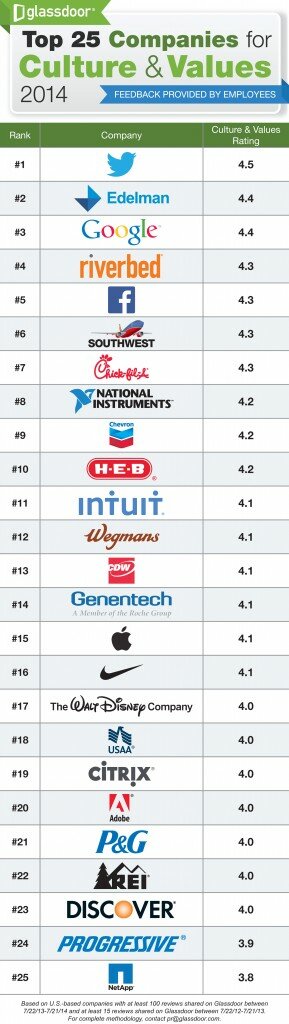
]]> So you’re looking for a job, right? But you don’t just want any old job. Your dream job needs to pay well, have great perks, and embrace a company culture you can identify with. Essentially, you’d like to be happy in your job and you don’t think that’s too much to ask.According to a newly released Glassdoor report detailing the top 25 companies for culture and values in the U.S., the majority of those looking for work feel the same way. It turns out that company culture is the second most important factor to job seekers — aside from salary, which is secure at number one — when researching employers.
Also among the other top five factors soon-to-be employees deem important are a company’s values, career opportunities within the company and location. “When we look at the reviews of these companies […], we see a few themes come through,” notes Will Staney, head talent warrior at Glassdoor. “Company culture is often described as supportive, motivational, team-oriented and fun. Another theme is that culture is the result of great values. We see reviews indicating these companies follow a set of values or mission statement and generally do the right thing.”
So which companies ranked the highest for their company culture and values?
The top five include Twitter, Edelman, Google, Riverbed Technology and Facebook. Not surprisingly, 11 of the 25 companies on the list hail from the tech industry, which is known for paying close attention to company culture and placing value in retaining talented employees.
“At tech companies, employers foster company culture by offering company-sponsored events or team bonding experiences, allowing for different physical accommodations to get work done and by promoting a relaxed environment,” says Staney. “Beyond culture, many tech employees feel they’re contributing to a greater good by working on products that impact millions of people around the world. This industry started the culture trend and now we’re seeing it spread to other industries.”
The report looked at companies through the eyes of employees and much of the qualitative feedback centers around how being a part of the company makes them feel. According to one Twitter account executive, there is an “open dialogue and [the company] cares about employees, which speaks to following through on their internal values.” At PR giant Edelman, a senior vice president notes, “Through the actions of middle to senior management, you are truly made to feel valued and appreciated. Opportunities are everywhere and the culture is laid back and fun.”
If you’re in the midst of a job hunt, you might be wondering how to best get a handle on a company’s culture and values during the discovery and interview process. According to Staney, your best bet is to start with good old-fashioned research. “Read company reviews and ratings to find out what others think of the culture and values,” Staney explains. “Beyond this, don’t be afraid to ask the question during your interview. Companies are looking to find candidates that fit within their culture and values, and as a candidate, you’re likely looking for the same […]. Questions show you’re looking for a company that fits you well, that you plan to stay at for a while.”
Here’s the full list of companies that ranked in the report:
Is company culture important to you? How do you work to improve the company culture at your company?
Jennifer E. Snyder is a freelance writer, editor and podcast host based in Northern California. She shares stories of creative entrepreneurship, wellness, life’s adventures and everything in between. When she’s not working, she can be found giving in to her insatiable urge to travel and explore the world as much as possible.
Get our best career advice delivered to your inbox. Sign up today!
The post Care About Company Culture? Work for One of These 25 Employers appeared first on Brazen Life.
]]> http://blog.brazencareerist.com/2014/08/22/care-company-culture-work-one-25-employers/feed/ 0The post Under-Qualified for Your Dream Job? Here’s How to Get Hired Anyway appeared first on Brazen Life.
]]> “Things may come to those who wait, but only the things left by those who hustle.” — Abraham LincolnIf all you did was submit your cover letter and resume, you’re screwed.
Why? Because someone out there speaks one more language, has a one point higher GPA or has one more year of experience. I don’t care how qualified you are. This is the wrong game to play. Let’s be honest: There are a lot of qualified people out there.
Of course, credentials can sometimes be necessary. If you want to be a doctor, you’ll need to go to medical school first. But as a rule of thumb, you should never lead with your experience.
This is especially true if you’re a young professional. For millennials new to the workforce, credentials take time. Fortunately, fit is often much more important than experience. (Click here to tweet this thought.)
If you want to stand out from all the noise, take these three steps:
Job listings are red herrings. Most large companies use computer algorithms to do keyword searches on your resume. This means you’re just about as likely to get a job from applying online as you are to win the lottery.
Instead, go to LinkedIn to figure out how you’re connected to the type of companies you want to work for. Then, form a relationship with an actual person who works there (ideally in person or over the phone).
You’re more likely to get a job if you know someone at the company, especially if they submit your resume and recommend you to the hiring manager.
Besides, most jobs never get listed. They are here one day and gone the next. Networking can help you get wind of of these opportunities before they are filled.
Sure, you can browse the company’s website. But don’t stop there. Everyone else already does that. Instead, dive deeper to figure out what that company’s biggest frustrations or opportunities are right now.
Reach out to your company contact or anyone else in the same industry and find out what they’re obsessing about on a daily basis. Use what you find to customize your resume. The key here is to figure out what this company would write a blank check for.
And it’s not just about your ability to solve business problems. Cultural fit is important, too. Learn what types of people this company wants around.
If you don’t care about the answer enough to ask this question, it probably isn’t the right job for you. Don’t even bother interviewing.
Of course, the best way to learn about a place is to work there first. Which brings me to my next point…
The final step is to position yourself as the best possible solution to their problems. Remember, this isn’t about you. Don’t spend the whole interview talking about what makes you great.
Most career counselors will tell you to talk about yourself first and ask questions at the end. This is a stupid strategy. The person who gets the job isn’t always the best option on paper; it’s the person who feels right.
If the interviewer asks you a direct question, set yourself apart in your response. Then ask a question. Ask first, and talk about yourself later.
In your thank you email, try sending the person a few links related to their challenges and include a summary of each. Or put them in touch with someone you know who might be able to help. If they need a new logo designed for one of their projects, literally draft a new logo for them — or put them in touch with someone who can.
The idea is to start working for them now so you can keep your foot in the door. Don’t start negotiating until you’ve demonstrated your value. Once they want you badly enough, it will be much easier to craft the specifics of your offer (e.g. salary, flexibility, benefits.)
If you keep doing what everyone else is doing, you’ll get the same results. So be different. Make connections, figure out what the company actually needs and start providing value right away.
As a millennial, you know there is more opportunity — and more competition — than ever. The world is open to you, but only if you hustle. It’s time to start taking smart, consistent action.
What will you do to stand out?
Greg Faxon is a personal coach who helps people live deliberately so that they can get more out of life and business. Grab his free True North Toolkit and start walking a path that matters today.
Get our best career advice delivered to your inbox. Sign up today!
The post Under-Qualified for Your Dream Job? Here’s How to Get Hired Anyway appeared first on Brazen Life.
]]> http://blog.brazencareerist.com/2014/08/20/qualified-dream-job-heres-get-hired-anyway/feed/ 16The post Why Declining a Job Offer Could Be the Best Decision You Ever Make appeared first on Brazen Life.
]]> When you’ve been job hunting for ages, you may be tempted to accept the first offer you get — even if you sense it’s probably a bad fit. In a tough economy, you may feel lucky to have even been offered a position. But sometimes, it’s better to just say no.Granted, if you’ve been living off your credit cards for awhile and you’re about to be evicted, you can’t be picky about where your next paycheck comes from.
But if you want to make the next big step in your career, you can stand to be a bit more selective. (Click here to tweet this quote.) Go into each interview with an evaluative eye, and value yourself enough to turn down the wrong job.
Look out for these eight warning signs. If you notice several of these red flags throughout the interview process, think twice about accepting that job offer.
You arrived early, dressed the part and delivered smart, well thought-out answers to every question. But did your interviewer fare so well? Did they leave you waiting for 30 minutes? Did they constantly check their phone throughout the interview? Did they act as if they’d never seen your resume before?
It’s not a good sign when someone comes unprepared to an interview and fails to show you basic courtesy. If the hiring manager is late, unprepared and distracted, imagine what it’d be like to work with this person every day.
We all have our bad days, but a general feeling of misery hanging over the office should give you pause.
It’s OK to ask the interviewer what they like about working there; if they struggle to come up with a reason, it could mean that none exist. Encountering employees who seem unhappy, angry or bored is a red flag.
If you’re changing careers, you may have to accept a pay cut as you build new experience and skills. But be careful about how big of a step back you’re willing to take.
For example, if you’ve worked as a managing editor for the last few years, you probably shouldn’t accept an editorial assistant position just because you’re desperate for a change of scenery. Unless it’s guaranteed you’ll move up the ranks quickly (and get that in writing), the step in the wrong direction will raise a red flag on your resume.
Do your due diligence to research the company, both online and by asking your network. You want to know if this organization recently laid off a big portion of their staff or is struggling financially.
Find out if this is a job you’re still likely to have six months down the road. And don’t be afraid to address these concerns in the interview.
Whether because of a scandal or poor business practices, if the company isn’t well-respected in your industry, you don’t want that scarlet letter on your resume. Could working here could hurt your career advancement down the road?
Again, milking your network for information and online research (Glassdoor is a great resource) can usually tell you a lot about how the company operates and perceptions past and present employees have.
Respect your beliefs enough to turn down a job that goes against your morals. If you’re a staunch anti-smoking advocate, don’t take a job at an advertising agency whose main clients are cigarette companies. If you’re a Democrat, don’t take a job on a Republican’s campaign.
Working for a company that goes against your values will make every single work day difficult. You’ll also send mixed signals when you’re job searching down the road.
Maybe you discover that the job advertised is actually significantly different than the one you end up interviewing for. Or you’re offered a certain salary and benefits, then they change their mind at the last minute.
If the company seems like they’re trying to pull one over on you, do you really want to put your career in their hands?
You should be willing to be flexible for a job you really want, but don’t undersell yourself or allow yourself to be taken advantage of. Know your worth — but be realistic about your prospects.
Get details about the full compensation and benefits package before accepting any job offer.
If you encounter any of these eight red flags as you’re interviewing for a job, think twice about the job offer on the table. Remember that you want your next job to be the right move for you professionally — not just another dead-end job you’ll want to leave in a few months. If a job isn’t the right fit for you, hold out and keep searching for something long-lasting.
Have you made the decision to turn down a job? What were the red flags for you?
Michelle Kruse is the Recruitment Editor and Content Manager for ResumeEdge.com, a resume writing and editing service, where she manages a team of over 40 professional resume writers. Her prior experience includes 10+ years of hiring and recruiting experience and a background in coaching and leadership development.
Get our best career advice delivered to your inbox. Sign up today!
The post Why Declining a Job Offer Could Be the Best Decision You Ever Make appeared first on Brazen Life.
]]> http://blog.brazencareerist.com/2014/08/14/declining-job-offer-best-decision-ever-make/feed/ 3The post Productivity Hacks for Your Job Search: Search Smarter, Not Harder appeared first on Brazen Life.
]]> You likely began your job search methodically and with purpose. But over time, as multiple leads come in, as you write multiple resumes, and as you make multiple phone calls, both your desk and email inbox become filled with leads and questions. Your overflowing inbox is paralyzing.As you weigh your options, you feel like you cannot neglect even the smallest task. Doing so prevents you from moving forward and getting anything accomplished at all. At this point of overwhelm, try instituting the Marine Corps maxim: Do it, delegate it or delete it. (Click here to tweet this idea.)
This simple mantra is all you need to follow up and follow through with greater efficiency. It’s the same idea behind the organizational tip of touching each piece of paper only once.
Why is it important to follow this rule? Not only does it instill confidence in those around you, but it also helps maintain your confidence. The lurking knowledge that you’re procrastinating is a confidence killer.
And in the same way, it’s hard to feel at the top of your game when you know you’ve left behind piles of laundry, an unmade bed and a sink full of dirty dishes. Likewise, it’s hard to present your best self at an interview or coffee meeting when you have an inbox overflowing with requests, complaints and exhortations.
“Do” items include following through on all leads for all sources, be they be from networking events or friends-of-friends introductions. You should research every company or connection.
While you may not follow through on every opportunity or lead, you need to keep the mindset that your job search is your job. Don’t allow yourself to be sidetracked.
What, specifically, are you looking for? Any info on the company — their mission, their bestselling products or their competition — can help you. The more you know, the better you can align yourself as the candidate who can further their goals, enhance their status or plug holes using your own unique skill sets and ideas.
You might think you should have someone else do this background research, but this particular task isn’t the best use of delegation — a highly underrated skill set, by the way.
It’s far better to delegate those tasks you use as a form of creative procrastination disguised as “necessary” work. Do you honestly need to invest more time reformatting your resume, updating your website and even organizing your interview wardrobe? How do these tasks connect you with the right job or organization? The fact is, they don’t.
Unless you’re a designer or web developer, these tasks are generally best handed off to those trained in these skill sets. Not only will you give yourself time to focus on what only you can do, you’ll also end up with a far better looking document or site.
Do you keep posting your resume on random job sites all over the Internet? Delete that task from your to-do list. Focused follow through on personal recommendations and with accredited sites is far more likely to yield the results you seek.
You should also delete those leads you find via what I call “Internet daydreaming.” This generally looks like a job that was something you considered doing during your summers off in high school, which just happens to be in Hawaii.
You should still follow up on any personal ledes — don’t delete those. So when your child’s camp counselor suggests you get in touch with their cousin “because it seems like you have so much in common,” pursue it. Following through could reveal their cousin is the vice president of the firm you’ve been angling for a connection to for the last six months.
But regardless of whether these leads result in the outcome you want, you need to remember that personal leads are just that — personal. Thanking the person who offered them is mandatory to building the kind of effective, comprehensive network you will need throughout your career.
As you can see, adopting a “Do it, delegate it or delete it” policy gives you a framework for following up and following through during your job search. It’s important to be fully focused on dedicating your efforts to each day’s top priorities. This is a simple way to make sure your maximize your efforts to best achieve your goal: That perfect job.
Frances Cole Jones is a nationally renowned career expert, a top 5 speaker in Communication by Speaking.com, President of Cole Media Management, and the best-selling author of the new eBook Wow Your Way Into the Job of Your Dreams (Open Road). Connect with Frances on Twitter and at www.francescolejones.com.
Get our best career advice delivered to your inbox. Sign up today!
The post Productivity Hacks for Your Job Search: Search Smarter, Not Harder appeared first on Brazen Life.
]]> http://blog.brazencareerist.com/2014/08/07/productivity-hacks-job-search-search-smarter-harder/feed/ 2The post 4 Strategies for Finding the Right Recruiter for Your Job Search appeared first on Brazen Life.
]]> When looking for a job, do you still spend all of your time looking for openings on job boards and sending off dozens of applications? That’s so 2004! No one does that anymore.All the cool kids are using their network to get referrals for jobs that aren’t on job boards, and the coolest of the cool kids don’t just stop with people they know — they reach out and network with recruiters. But hold on, tiger. Don’t go firing off emails to every recruiter you come across. You have to find the right kind of recruiter for you. (Click here to tweet this list.)
First the obvious: use your network!
Reach out through LinkedIn, emails, or however you stay in contact with your contacts, and focus on people in your industry and with the same level of experience. See who has dealt with recruiters, or knows someone who has, and write down anyone who gets positive reviews.
Stick to recruiters in your niche. They will have dealt with companies and employers in your industry and can help guide you through the hiring process.
You might be thinking, “He just poked fun at job boards, and now he’s saying they’re useful?” Yes. Yes I am.
Good niche job boards have two advantages over larger, more general job boards like Monster and Indeed:
So, second verse same as the first — reach out to the community and see if people are willing to recommend recruiters they know and like. Barring that, you can see which recruiters and firms work in your niche.
Twitter has become a fantastic resource for both jobseekers and recruiters. You can use it to find recruiters in your niche and engage with them.
In the search bar, type something like “accounting recruiter” or “IT recruiter” to find recruiters who specialize in an industry or specific job. On the left side of the results page, click on “people” to narrow the search so you only find actual recruiters.
Another resource is Followerwonk.com, where you can perform the same type of search as on Twitter, but narrowed by location.
Check each person’s Twitter profile for links to a personal website or recruiting firm’s site. Recruiters you find this way will be similar to those you find on niche job boards — you’ll need to do some research on them unless you know someone who can recommend them.
Here’s a new twist on an old trick: A lot of recruiters use Boolean strings to find candidates through Google, job boards, or social media sites such as LinkedIn. You can use the same method to find recruiters.
You can use strings to search for recruiters on specific sites, such as LinkedIn. On Google, search something like the following: site:linkedin.com “marketing recruiter” AND San Francisco –inurl:dir.
Here’s that string broken down:
Basically, use the same formula and commands that recruiters use to find candidates, but sub in “recruiter.”
Once you’ve made a complete list, refine it to a handful of recruiters that seem best for you and your goals. Next, reach out to them while you keep in mind a few important things:
The last thing to remember is that these tips should not be the only method you use for finding a job. You shouldn’t stop searching through job boards — yes, job boards — and building your personal brand online.
Brian Stewart is a career content writer at ResumeTarget.com. They are the only resume writing company that offers a professionally written resume coupled with the guidance of recruiters to guarantee that your resume will get results.
Get our best career advice delivered to your inbox. Sign up today!
The post 4 Strategies for Finding the Right Recruiter for Your Job Search appeared first on Brazen Life.
]]> http://blog.brazencareerist.com/2014/08/05/4-strategies-finding-right-recruiter-job-search/feed/ 4The post 10 Hacks for Using Indeed.com for Your Job Search appeared first on Brazen Life.
]]> Whether you’ve been looking for a new job for five minutes or five months, you have one thing in common with every other job seeker on the planet: You’ve visited Indeed.com at least once.Love it or hate it, Indeed is one of the most popular search engines for job seekers. It’s a powerful search engine with the muscle, intelligence and flexibility to help you find just about every open position out there — which can also be overwhelming and problematic, leaving you exactly where you started: Still wanting a new job, but lost as to how to find the right opportunities.
Indeed’s search results will vary from day to day or even hour to hour as new jobs open and others close. The job that was open yesterday morning may not be listed today. Of course, the reverse is also true — you found nothing in your search yesterday, but today could be your lucky day because an employer (or several of them) posted new jobs that are just up your alley.
If you don’t find that perfect-fit job today, try again later today, tomorrow, next week or next month. You can also set up an Indeed “Job Alert,” to be notified via email as soon as positions that meet your selection criteria are posted.
Like any other search engine, there’s an art to searching Indeed. (Click here to tweet this quote.)
Take a search for an office manager position. Type those two words into the search bar, and you’ll get jobs that contain both the words “office” and “manager” in no particular order. Some postings may have those words side-by-side or in two different places. The “manager” and “office” aspects of the job could be completely unrelated to each other.
So, results might include jobs like “Product Support Front Line Manager, New York office” or “Bookkeeper/Office Manager.” You might also get results that include the words “office” and “manager” just about anywhere in the job description.
This simple search is best used when you want to find jobs or employers requiring a specific degree (like BS or MBA), a professional designation (like CPA), a certification (like PMP) or something similarly specific that contains only one distinct word. Then the results could be useful to you regardless of where the term appeared, in the job title or in the description.
These search shortcuts will help you cut through the noise find exactly the positions you’re looking for. All these hacks apply only to Indeed.com’s “what” search box. Add your preferred location to the “where” box, or leave “where” empty to see what’s available across the country.
To tell Indeed to search a specific phrase, enclose the words in quotation marks.
You can also search for specific job titles on Indeed. Pretty simply, too. Just add the word “title” followed by a colon: What -title: accountant
Indeed will then search only the titles of postings. Remove the title:, and the search engine will also look for those words in both the job title and the body of the job description.
Since there are so many different types of accountants, ask Indeed to find exactly the ones you want. For this example, let’s use tax accountant.
If the job title is a phrase, like tax accountant, combine Hack # 1 and Hack # 2 to be more specific: What -title: “tax accountant”
In this case, you’re telling Indeed you want to only see jobs with titles that include the words “tax accountant.”
Like specifying the job titles you want, you can also tell Indeed to find your target employers. Similar to the way you tell Indeed to find specific job titles for you, have Indeed search for jobs with a specific employer by typing in the company name.
For example, let’s say you want to work for XYZ Company. You’re curious about what job openings they have right now. To find open jobs at XYZ Company, use this query: What – company: “XYZ Company”
Combine Hack # 3 and Hack # 4 to find specific job titles with a target employer. So, if you wanted to be a tax accountant for XYZ Company, your query would look like this. What -title: “tax accountant” company: “XYZ Company.”
Maybe you’re trying to figure out which jobs are best for you by exploring job titles used to describe people who have similar skills. Or maybe you just want to see jobs that require a specific skill set you have or are considering acquiring.
In this example, we’ll assume you’re curious which employers need people with social media skills. So, you would do this search: What - “social media”
You know exactly the job you want, and you’re looking for that job with a specific skill set included. So, if you wanted to find executive assistant jobs in the real estate industry, you would combine a job title search with a keyword search.
That search would look like this: What -title: “executive assistant” “real estate”
Say you want an administrative assistant job, but you don’t want to be the receptionist, too.
To find the admin assistant jobs that exclude those with receptionist duties in the descriptions, your search would look like this: What – title: “administrative assistant” -receptionist
In this example, you’ve decided you want that administrative assistant job (without receptionist duties) at our mythical XYZ Company. Your search would look like this: What -title: “administrative assistant” -receptionist company: “Example Company”
To refine your search results even more, try Indeed’s Advanced Job Search. You can specify estimated salary ranges, job type (full-time, part-time, contract, internship or temporary), and other interesting options.
Susan P. Joyce is an online job search expert observing the online job search world and teaching online job search skills since 1995. Susan is a two-time layoff “graduate” who has worked in human resources at Harvard University and in a compensation consulting firm. Susan is editor and publisher of Job-Hunt.org and WorkCoachCafe.com. Follow her on Twitter at @JobHuntOrg for more job search tips.
Get our best career advice delivered to your inbox. Sign up today!
The post 10 Hacks for Using Indeed.com for Your Job Search appeared first on Brazen Life.
]]> http://blog.brazencareerist.com/2014/07/30/10-hacks-using-indeed-com-job-search/feed/ 0The post How to Accept a Job Offer: 5 Crucial Steps Before Saying Yes appeared first on Brazen Life.
]]> After a challenging job search, you finally received the call you’ve been waiting for! Your interviewers liked the potential they saw in you, and a few days after your final meeting, they picked up the phone to tell you the good news: You’re the one they want. They’d like to offer you the position and they hope you’ll accept their terms and start working as soon as possible.You may be pleased and flattered by the offer, but before you say yes, make sure you pause and take these five critical steps. (Click here to tweet this list.)
Whatever you do, don’t let the excitement of the moment push you into a hasty decision. Your employers will probably discuss your candidacy in glowing terms and tell you how happy they were to meet you and how optimistic they feel about bringing you onboard. They’ve already decided that you’ll make a great addition to the team, and they’ll probably enjoy sharing this with you. But don’t get carried away. Accepting a job can be a major life decision, and before you say yes, you have the best possible opportunity to negotiate the terms of your agreement.
Before you get down to business and start talking about the terms of your employment, thank your potential managers for the offer. Saying thank you won’t lock you into a commitment — it’s just a pleasant and professional way of showing respect and gratitude.
Expect your potential employers to include a clear annual or hourly salary rate in their informal offer. They should also include a clear explanation of your basic insurance benefits, commission details and bonus rates with the intention of listing these again in a formal written offer later on. But be aware that they may not do this and may expect you to speak first and clearly state the preferred terms of your employment. If you’ve done your research and have an answer ready, feel free to share your terms. But if not, don’t speak until you’re ready.
No matter the terms of your employment, and no matter who speaks first during your negotiation process, ask for at least 24 hours before you provide your official answer. This will give you time to discuss your decision with your friends and family, and it will give you the time to conduct some research into the standard salary and benefit rates for this type of position if you haven’t done this already.
If your current position involves an “at-will” agreement between you and your employers, then legally, you’re free to walk away at any time for any reason. But for the sake of courtesy and professionalism, it’s a good idea to give your employers two weeks’ notice before you walk away. Your new managers will probably factor this two-week period into your start date, but if they don’t, you’ll need to make this request on your own. Make sure you leave your previous employer on good terms, and make sure you’re satisfied with your formal written offer before you sever your existing ties.
Jenny Treanor is a career advisor and job search expert who provides consultation for staffing firms, hiring managers and job seekers across every industry. Her blogs and articles appear regularly on LiveCareer, home of America’s #1 Resume Builder.
Get our best career advice delivered to your inbox. Sign up today!
The post How to Accept a Job Offer: 5 Crucial Steps Before Saying Yes appeared first on Brazen Life.
]]> http://blog.brazencareerist.com/2014/07/24/accept-job-offer-5-crucial-steps-saying-yes/feed/ 6The post How to Find a New Career: Avoid These 5 Mental Traps appeared first on Brazen Life.
]]> You probably fell into your current career.Yes, I know you planned. You carefully considered your choice of degree. You got a job you were qualified for.
But you only assessed opportunities that were right in front of your nose.
Your choices were (unwittingly) limited. Limited by your environment. Limited by the expectations of friends, family and teachers — and yourself.
Career theorist John Krumboltz called it “planned happenstance.” A bit of planning, yes. But also luck. Being in the right (or wrong) place at the right time.
Instead of fishing in a pool of limited options, you have the chance to find where the most delicious fish are swimming.
Then, when chances do arise, you will be ready, and want, to say yes.
Increase your luck by knowing the five most common reasons people stay limited: (Click here to tweet this list.)
You think you need to be sure of your passion before you can make it a reality. Not knowing is paralyzing you.
You are afraid that making the wrong decision will have you go through the pain of change for nothing, especially if you are interested in a radically different career.
So you take no action at all.
The truth is, to find a career you love the action comes first, then the decision.
Find ways to test the water before diving in. Pick small, frequent actions that give you insight into potential careers, without making a commitment (yet).
Simply talk to someone already in a job you’d like to explore. Even better, shadow them for a day.
Want a creative career? Create intensively for 30 days.
Or come up with five ideas for how you might get paid for activities you already do for free, or used to love doing as a child, and implement one of them.
Learn from doing. Then decide if you want to commit.
It is dumb to decide you can’t do something before you’ve even tried it.
Throughout history people have made things happen, despite barriers bigger than most of us will ever face.
Maya Angelou became the first black female bus conductor in San Francisco by turning up every day for nine months, even though she’d been turned away on the first day.
Annys Darkwa came out of prison and founded a social enterprise while living on welfare payments.
Grace Quantock became a writer and award-winning entrepreneur despite living with chronic pain and multiple disabilities.
Realistic is a state of mind.
If you knew you could not fail, what would you do with your career?
We are all busy. But we are not all victims of our busy-ness.
Do you ever watch TV, use social media or go to the bar? Then you can choose to make time to work on your career.
On a scale of one to 10, how much of a priority is your career? Seven or above?
Then make time.
You are in the right place. Find one to three articles on Brazen that solve your biggest problems.
Don’t just read them, do what they suggest. Otherwise you have just found another way to put off taking action.
Try articles that help you find ways to meet potential employers or customers, use online tools effectively and apply for jobs in compelling ways.
Stick to a few actions that you will do thoroughly. Set a deadline, and find a buddy who will hold you accountable.
I know this sounds backward, but taking steps toward something you deeply care about can be terrifying.
If you fail at this, what do you have left? You will have killed the dream.
The more important something is to you, the more scary it is.
The reverse also applies. The scarier something is, the more likely that you are going in the right direction.
Hear your inner critic screeching ever more loudly? Is that voice in your head telling you that this is too risky, you are not up to it, people will judge you?
Good. Then you are probably on the right track. You are worth the risk.
Adjust the details of your action plan if you need to.
But don’t stop.
Devi Clark is an author and career coach at NewLeaf Coaching, which specializes in helping career changers find work that makes a difference. She is founder of the Outsiders’ Network, a community for people who feel different from the social norm.
Get our best career advice delivered to your inbox. Sign up today!
The post How to Find a New Career: Avoid These 5 Mental Traps appeared first on Brazen Life.
]]> http://blog.brazencareerist.com/2014/07/23/find-new-career-avoid-5-mental-traps/feed/ 6The post How to Answer the 5 Toughest Interview Questions with Confidence appeared first on Brazen Life.
]]> The interview process can be a nerve-wracking experience. For some, it’s tough to be the center of attention answering rapid fire questions for 30 minutes. Others lack the confidence and organization to make sure they hit all the points they want to emphasize.But, undoubtedly, the most stressful part of interviews is the standard questions that seem to have no good answer, the ones that have plagued every job seeker before, and often during, the actual interview. No need to worry though: there’s a way to answer those questions in a manner that’ll satisfy the interviewer and portray you in a positive light. (Click here to tweet this bit of hope.)
Whatever your feelings about your current employer may be, you never want to speak poorly of the company — and you don’t want to paint yourself in a negative light either. Make it simple: you and the company are no longer a good fit.
Of course, you’ll have to go into a bit of detail, but make it about your long term goals and how they don’t align with what your company can offer you. During this part of the interview, strike a balance between offering some detail without rambling on. The worst thing you can do is throw your current employer under the bus, so make it a no-fault conversation.
One of the cardinal rules of an interview is to remember that you’re interviewing for a specific job, not for the one you want in the future. That being said, it’s almost a certainty that interviewers will ask about your goals and aspirations. When answering this question, tie it back to the position you’re actually interviewing for.
A good answer is to say that you want to grow within the organization, using the position you’re interviewing for as a basis to learn. Make sure to keep it within the same industry though. If you’re interviewing for a position in HR, don’t say your five-year goal is to work in finance — that won’t sit well.
Employers like to know you see a job in their company as a stepping stone to more senior roles within their company — certainly not within an entirely different industry
This is one where interviewers will look for the most honesty, so avoid the standard “I work too hard” answer; it’s a safe one and comes across as such. Instead, be honest about the things you need to work on — whether it’s overseeing a team or managing budgets.
As long as you remember to bring it back to how you’d like to learn more, you’ll have the interviewer’s respect.
Given the recent recession, it’s not uncommon to have some holes in your resume. Yet, interviewers want to hear how you used that time off to still progress your career in the long run.
Perhaps you went back to school to get a degree, took a specific course to improve your skill set, or even volunteered or interned at an organization to keep your skills fresh. Either way, employers want to see an effort to learn transferable skills, no matter how you do so.
This is the time to sell yourself, but too many people are afraid of sounding boastful. Don’t be. Use this opportunity to show how your skills align with those that the position requires.
You might say, “What I’ve heard from you is that this position requires XYZ, and my prior experience doing ABC has prepared me to do that very well.” Ask questions so you can clarify and amplify your qualifications. This question allows you to put your best foot forward and make your case for the job, so take advantage of it.
Sure, it can be anxiety inducing, but at the end of the day, an interview is an exciting first step in the process of finding a job that meets your needs and allows you to reach your goals. Once you have the confidence to answer the toughest questions, you’ll be able to go far in your career.
Jennifer Kochilaris is a Regional Vice President for the South Florida region of Adecco Staffing, US. She manages 27 colleagues within her organizational structure and is proud to work with them to support hundreds of clients within a variety of industries in the South Florida market.
Get our best career advice delivered to your inbox. Sign up today!
The post How to Answer the 5 Toughest Interview Questions with Confidence appeared first on Brazen Life.
]]> http://blog.brazencareerist.com/2014/07/22/answer-5-toughest-interview-questions-confidence/feed/ 7The post 3 Tough Job Interview Situations and How to Handle Them appeared first on Brazen Life.
]]> Once the interview is over and you’ve landed the job, it’s smooth sailing from here on out, right?Not exactly.
If your job includes communicating with clients and closing deals, you’ll have to go through the job interview process over and over again. Luckily, you can translate the skills that got you in the door to help your sales shoot through the roof. (Click here to tweet this thought.) Here are a few interview situations and how you should handle them:
When an interviewer asks you about a skill you don’t have, you have three choices: you can misrepresent yourself and hope you don’t get caught, say you don’t have the skill and wish them luck on their candidate search, or you can emphasize a related skill you have while expressing your eagerness to learn and quick mastery of new material.
The first choice is not only pretty unethical, but also a great way to burn bridges within your industry. If the skill is important enough to be mentioned in the interview, it’s probably used frequently; you’re going to get nailed on it sooner or later.
Compare this with a prospect asking about a product you don’t have or a service you don’t provide. They need 24/7 communication, and you have a strict “no work on weekends” policy. You can say you’re always available, but if it’s important enough for them to ask in the interview, you can bet your phone will be ringing on a Saturday. Are you willing to answer it?
The second choice is more ethically balanced, but doesn’t do your business any favors. You came into the job interview for a reason and did your research. Unless there’s a huge miscommunication on the nature of the business, you should have something to offer.
Few business “soul mates” exist, so if you bow out the moment you think you can’t reach their ideal, you’re going to be turning away perfectly good business. Ask questions to probe deeper; they may be asking for a particular service or product, but what they really need is for you to fill a need. If you can discover what the client needs, you may be able to offer something of your own that would make you a perfect match.
If an interviewer asks you a factual question, and you know the answer is on your resume or in your cover letter, it’s not because they’ve forgotten. They’re giving you an opportunity to tell them how that fact makes you the perfect candidate.
Interviewer: “It says here that you studied at Prestigious University.”
Wrong answer: “Yep.”
You just blew an opportunity to tell the interviewer how getting the Perfect Degree at Prestigious University and your school involvement makes you the best person for the job. On the other hand, the interviewer might bring up something on the resume because he or she is confused about it, and it may be broaching a delicate topic.
Interviewer: “I see a two year gap between your jobs at First Company and Second Company.”
Wrong response: “That’s correct. I did not work in 2010 and 2011.”
See the pattern? A prospect may ask about any number of things, and it’s your job to spin everything in a positive light.
Prospect: “It says on your site that you were named the Top Widget Seller of the Decade.”
Wrong response: “Yep.”
Right response: “It sure is! We competed against thirty-four other widget manufacturers and were rated in three different areas including customer service satisfaction. You mentioned earlier you had trouble with your last supplier and their bad attitude. I’m glad we can show you have a track record of happy customers.”
Typical interview etiquette tells you to follow up to thank the person interviewing you immediately with a handwritten, mailed thank you card.
Why not transfer this practice over to meeting prospects? If you maximize every moment with potential clients, then you have – at minimum – learned about their company, made a networking contact and practiced your sales pitch. For that alone, they certainly deserve a thank you card.
Even if you don’t happen to match what they need for this job, you made a positive contact and put yourself in an excellent position to be contacted in the future.
Treat every discussion with a prospect with the same preparation and positive attitude you did during your interview for the position, and you’ll get that same fist-pump high-five feeling of being hired over and over again throughout your career!
Bret Bonnet is the CEO of Quality Logo Products, a promotional products distribution company that he helped to establish in 2003. His efforts earned him a spot on Counselor Magazine’s list of the top 30 entrepreneurs under 30 within the promotional products industry.
Get our best career advice delivered to your inbox. Sign up today!
The post 3 Tough Job Interview Situations and How to Handle Them appeared first on Brazen Life.
]]> http://blog.brazencareerist.com/2014/07/07/3-tough-job-interview-situations-handle/feed/ 6The post 5 Tricks for Turning Your Summer Internship or Temp Job into a Full-Time Job appeared first on Brazen Life.
]]> It’s summertime! After long semester, you’re ready to hit the ground running. This will be the summer you’ll gain valuable work experience that will pad your resume for life after graduation.Whether you’re working an unpaid internship or picked up a temporary administrative job to earn extra cash, make this summer count. Just because you’re in a temporary gig doesn’t mean you can slack.
Believe it or not, your internship or admin job can serve as the perfect jumpstart to your career for life after graduation. Follow these five steps to leave a long-lasting and positive impression. (Click here to tweet this list.)
“If you’re early, you’re on time. If you’re on time, you’re late.” This is what my first mentor shared with me as the secret of successful first impressions. Being punctual demonstrates you respect your employer’s time.
While everyone has days where something comes up — an epic commute due to an accident or other roadblocks that are out of your control — don’t fall back on these excuses frequently. Make an effort to be on time.
It doesn’t matter if other employees in the office strolls in late. As a temporary employee or intern, you want to leave a good impression. Make a point to be early.
It’s often easy to identify the “the temp” or “the intern” just by looking around the office. Don’t let this happen to you. Leave your flip flops, short skirts, jeans and other summer wear at home. Save your ripped jean shorts or cute summer dress for the weekends — not the office.
Even though you’re low on the totem pole, dress professionally so your employers can treat you an equal. First impressions do matter!
While on the job, take a much needed break from social media, G-chat and texting. You’re here to work, not to hang with your friends online. These distractions can get in the way of your career.
Yes, you may find yourself struggling with FOMO. But remember your employer has clear expectations on why you’re here for such a short time. They want you to support them on a specific project or task.
So while you’re on the job, try to let go of the distractions and pay attention to the work in front of you.
Always maintain a positive and enthusiastic attitude to whatever task you receive. This is the ultimate “make it or break it” on whether you get promoted to better projects or are offered a permanent position.
As a temp or intern, you may assigned to take care of menial, administrative tasks such as opening the mail, filing and copying. Treat each task as if it’s important (because it is.) Employers use your attention to detail and attitude to gauge your initiative, willingness to be part of the team and your work ethic.
Your boss can see when you roll your eyes and knows when you complain about your tasks. Keep those gripes to yourself. Your reputation — and future career — will thank you.
Socializing at work is a great way to connect and network. With that said, you want to stay as far away as possible from any office gossip. Avoid bad mouthing your coworkers or spreading rumors you may have overheard.
Remember, even if you do not continue working long-term with this company, you’ll likely want a reference or two at the end of your assignment or internship. To stay in the good graces of your employer, don’t engage in the office politics.
Look at your temp or internship experience not as a short-term in-between gig, but as an amazing opportunity for professional growth. These few months will help you expand your network and gain new skills and experiences that will come in handy in the future — so make this time count.
Laura Yamin is a Career Coach. She works with women who’ve decided they are done living their lives to please everybody else and are ready to transition into a career that makes them excited to get out of bed on Monday mornings.
Get our best career advice delivered to your inbox. Sign up today!
The post 5 Tricks for Turning Your Summer Internship or Temp Job into a Full-Time Job appeared first on Brazen Life.
]]> http://blog.brazencareerist.com/2014/07/02/5-tricks-turning-summer-internship-temp-job-real-job/feed/ 9The post Why You Should Stop Looking for a Job, and Improve Your Skills Instead appeared first on Brazen Life.
]]> Today’s job market is changing dramatically. Companies are constantly hiring and firing and the days of lifelong careers at a single organization are over. We’re living in a “gig economy” where one- to five-year stints are the norm and people need to plan their careers around a market that’s becoming more unpredictable.From an employer’s perspective, it’s all about relevancy. How relevant are the skills you have to solving the problems my business faces? From an employee’s perspective, it’s about building marketable skill sets to leverage from one opportunity to the next. In this marketplace of skills, why do people still focus on finding jobs?
Take a look at resumes. Resumes speak to who you were — jobs you held in the past, education completed, etc. They do not reflect what employers really care about — how you will help them advance their organizations. Employers hire skills and future potential, not credentials and past accolades. (Click here to tweet this.)
This idea of “skills” has changed how I perceive my career planning as well as that of the people who work for me. Rather than looking at positions as jobs with specific pay and responsibilities associated, we try to look at them as periods in which you’re developing specific skills that will help grow our business. This philosophy enables honest conversations around each employee’s role and allows us to work together to develop skills that we need and that they want.
In pursuing a skill-focused career planning philosophy, I look at three aspects that help answer the question: What skills do I choose to acquire and how do I position myself to receive opportunities that leverage/grow these skills?
About nine months into starting my company, Growth Spark, I had to decide whether to continue freelancing or to build an agency. I figured the best way to determine what hires I needed was to examine the role that I saw myself playing in the business.
So I developed what I call “base analysis,” which I conduct annually to determine what skills I need to develop. Base analysis looks at the individual tasks I perform and asks three questions:
I get as granular as possible in evaluating the answers to these questions. Anything that scores a yes to all three, I continue to perform. This same process can be applied for skills-focused career planning to look at current (and past) jobs and list the tasks/roles you’ve performed. Focus your career planning around leveraging your strengths and going after “Level 3” skills.
Once you’ve identified the skills to develop, set yourself on a track of continual learning. I like drawing from the Japanese work philosophy “kaizen” about continuous incremental improvement. In a market where technology evolves at a pace that can retire skill sets in just a few years, continuous self-improvement is a necessity.
Luckily, many entrepreneurs have capitalized on this trend by creating alternative education companies. Organizations such as General Assembly provide online and offline courses to help working professionals continue building skills in marketing, design, business strategy, etc., at a fraction of the cost of traditional education.
The last piece in skills-focused career planning is about positioning yourself to get opportunities to continue to refine these skills (while getting paid). I often suggest to people evaluating job opportunities that they view themselves as a consultant. The potential employer is a client who needs help solving a particular set of issues that match your skill sets.
The most successful consultants focus on marketing themselves as a unique brand and sell their portfolio rather than their resume. Consultants continually demonstrate their expertise through blogging and social media, as well as by speaking and building a personal website to showcase their portfolio.
During college I had an internship with a consultancy that worked with startups. My boss (now mentor) said something that stuck with me: “Learn before you earn.” The idea of building one’s career around learning and acquiring skills develops the resiliency necessary in today’s unpredictable job market.
Ross manages Growth Spark, a Cambridge, MA, based agency that helps e-commerce companies design interfaces that convert visitors into customers. A graduate of Babson College, he is a serial entrepreneur in the technology space with experience in digital marketing, business development and strategic management.
Get our best career advice delivered to your inbox. Sign up today!
The post Why You Should Stop Looking for a Job, and Improve Your Skills Instead appeared first on Brazen Life.
]]> http://blog.brazencareerist.com/2014/06/25/stop-looking-job-improve-skills-instead/feed/ 7The post 2 Questions You Should Ask Before Leaving Your Job Interview appeared first on Brazen Life.
]]> Do you know the impact key words and powerful phrases can have during a job interview? You may think think the interviewer is judging you as a whole, taking into account everything from background, experience and professional demeanor to personality and favorite hobbies.The truth is, most interviewers judge you based on what you say and how you behave (body language) before they evaluate the details of your resume.
Ninety percent of hiring decisions are made on an emotional, gut level. (Click here to tweet this statistic.) Candidates are hired based on the right turn of phrase, strong handshake or eye contact — and the rest is emotional justification. Psychologists call this “motivated reasoning.” Most business decisions are made in this way, with little logic.
While most job seekers focus on coming across as competent in the interviewing process, the successful ones focus on being likable and memorable. The use of key words and phrases play an important role in this.
For example, try to end your first interview by asking the interviewer two questions:
These questions can make an enormous difference between getting a second interview (or hired) or waiting by the phone for weeks. Not long ago, one of my hiring clients interviewed seven candidates for a mid-level purchasing managerial position.
The candidate we referred for the position, Mary, used these questions to close her initial interview. The interviewer took notice and told us Mary was the only one who asked how she compared to the others. When he kicked her resume up to the next group of interviewers, he told them, “I interviewed several candidates initially and she was the only one who asked for the job. I really like her.”
Mary spent a mere two and a half hours interviewing with this company — one hour at the initial interview and an hour and a half with the next group. She became the “best” candidate because of the powerful phrases she used in the interviewing process.
In fact, the vice president of procurement told her that while she wasn’t the most qualified applicant, she had come across much better than the others during the interviews. Mary was hired and she’s convinced that these two simple questions helped her nail the interviews and land the job.
Most job seekers are surprised to learn that during an average hiring cycle, you need to spend four hours in face-to-face interviews. The interviewers listen intently to what you have to say, so you don’t have a lot of wriggle room for making mistakes, flubbing or forgetting. Most mistakes candidates make center around saying the wrong thing or saying something that is interpreted the wrong way.
To overcome missteps during an interview you have to be prepared — and to be prepared you must practice, practice, practice. Even if you’re good at talking about yourself and fast on your feet, interviews have their own particular language. Learn it backward and forward – or you risk saying the wrong thing.
Here are some strong words you can use to describe yourself: passionate, practical, quick study and good communicator.
Keep in mind that throughout the job-hunting process you must be courageous in your quest for a job, putting yourself out there despite knowing you’ll be greeted with rejection.
Analyze interviews that don’t bear fruit, learn from them and move onto the next. Maybe you ended on a weak note, saying something like “Well, where do we go from here?” Or “I might be interested.”
Instead, asking the interviewer how you stack up to the competition, and what you can do to get the job, indicates courage. You’re telling them, “I’m a serious candidate. Hire me.”
Tony Beshara is the owner and president of Babich & Associates, established in 1952 and is the oldest placement and recruitment service in Texas. He has been a professional recruiter since 1973 and has personally found more than 8500 individuals jobs. www.thejobsearchsolution.com
Get our best career advice delivered to your inbox. Sign up today!
The post 2 Questions You Should Ask Before Leaving Your Job Interview appeared first on Brazen Life.
]]> http://blog.brazencareerist.com/2014/06/25/2-questions-ask-leaving-job-interview/feed/ 2The post 3 Reasons Having a Professional Website Will Land You Your Next Job appeared first on Brazen Life.
]]> Head to any website targeted toward the self-employed and you’ll hear the same thing: You need a website to land clients. But what about those with more traditional jobs: Why consider creating a website? Maybe you’re happy with your traditional job, and you’ve got a killer resume. That’s all you need, right?Unfortunately, a killer resume doesn’t always cut it. You’ve likely experienced this firsthand, having gone into interview after interview with little to show for it. But there’s nothing more you can do to make your resume shine short of printing it on pink scented paper (and Elle Woods already did that one).
At this point, it’s time to give yourself more of an edge in the job hunt. How do you do this? One way is to create a website. (Click here to tweet this thought.)
Not sure if creating a website is worth it? Here are some reasons why a website is a good idea even when you’re a traditional employee.
It can be tough to show what you’re capable of in an interview or through a one to two page resume. With your website, you can do more to showcase your talents, and since it’s available publicly, you can reach more recruiters while giving them a convenient path to your portfolio.
Imagine this:
Instead of handing over a portfolio binder to the hiring manager, you give him access to your site by sharing your domain name. He’s stunned by your professionalism (and thankful he doesn’t have to worry about carrying around or misplacing your binder), and you don’t have to worry about getting your binder back before your next interview. Plus, you can incorporate digital content on a website, like an introduction video.
But this portfolio option only raises more questions. Why not just use LinkedIn or other platforms to showcase your expertise? Three reasons:
Another major question you probably have: What should I include in my portfolio? Try incorporating these elements:
Consider these examples of professional portfolios in various industries for inspiration:
Let’s say you set up a website. You’ll probably list it on your resume so hiring managers can learn more about you.
But your website can do so much more than that. Before you even see a job listing and apply to it, most hiring managers are already looking for you. Today, 80 percent of jobs are never listed, reports CNN.com. That means hiring managers are already on the search before you are.
How are they finding these qualified individuals? Many will tap into their networks and receive recommendations from people they already know, while others will go on the search themselves.
When recruiters look for qualified individuals, they might start with search engines, head to directories or go on a social media search. With a website, you can reel in those recruiters by having extra to offer. It’ll help you stand out from the crowd.
Even more than that, a website expands your visibility. If a recruiter uses a search engine, your website is more likely to show up than your LinkedIn profile. And if you have a blog, you could attract hiring managers to your site when they’re not even looking. They might like what they see and contact you.
How can you make your website more visible?
Brazen has talked about how blogging can boost your credibility countless times. As you blog in your niche and market that content, you can create a social following.
If you could tell a hiring manager you have 10,000 email subscribers on your industry-related blog, you’d probably raise a few eyebrows. This alone can serve as proof of your expertise, giving you stats to measure your success by and show that people hold you in high esteem within the field.
Check out these great posts for more about using your blog to get a job:
While a website is certainly a great job-landing tool for some people, it doesn’t always make sense for every job seeker. Consider starting a website when:
Are you ready to boost your professional appearance and start seeing more results from your interviews? Start by digging into how to build a website with PCMag’s guide.
Alicia Rades (@aliciarades) is a freelance blogger and writer eager to create content on blogging, writing, and career topics. Learn more about her and her blogging services at aliciaradeswriter.com, where you can download her free Which Freelance Blogger Should I Hire? Worksheet.
Get our best career advice delivered to your inbox. Sign up today!
The post 3 Reasons Having a Professional Website Will Land You Your Next Job appeared first on Brazen Life.
]]> http://blog.brazencareerist.com/2014/06/24/3-reasons-professional-website-will-land-next-job/feed/ 6The post You Won’t Believe the Theme of This Coworking Space appeared first on Brazen Life.
]]> Freelancers, entrepreneurs and side-giggers: Have you ever thought of joining a coworking space? It seems they’re popping up everywhere lately as a way to maintain in-person connections even when all your work is online.Here’s a new coworking space to add to the list: Green Labs in Denver. To a casual observer, this shared office looks like all the others: sleek furniture, open workspaces, fast wifi, strong coffee, and plenty of networking events and classes.
Sounds great, right? Well, there’s a catch. As the world’s first cannabis coworking space, you can only join Green Labs if you work or invest in Colorado’s legal marijuana industry.
Don’t start picturing an office filled with bongs and Twinkies, however — this is much more than a high-tech frat house.
Two University of Michigan entrepreneurs recently founded Green Labs with the hopes of centralizing investment in the cannabis industry.
In their words:
“We cater to the new and rapidly expanding cannabis industry precipitated by the legalization of recreational marijuana in Colorado. Our members work side-by-side with other entrepreneurs, attract venture capital and private funding through our investment arm, the Denver Angels, and learn best practices in digital marketing, programming, and legal strategy.”
Since several states are soon predicted to follow in Colorado’s and Washington’s footsteps, THC-centric startups are only expected to grow in number — which means there might be a Green Labs in your city before you know it!
What other interesting coworking spaces have caught your eye?
Susan Shain (@TravlJunkette) is a travel blogger who loves helping people discover adventure through international travel or alternative careers.
Get our best career advice delivered to your inbox. Sign up today!
The post You Won’t Believe the Theme of This Coworking Space appeared first on Brazen Life.
]]> http://blog.brazencareerist.com/2014/06/19/wont-believe-theme-coworking-space/feed/ 2The post How to Write a Resume: A Totally New Approach That Will Get You Hired appeared first on Brazen Life.
]]> What if there was a way to truly land your dream job?I’m not talking about landing your dream job in the world of unicorns and rainbows, but in the real world — the one where you have bills to pay and maybe even mouths to feed. What if you could know what you love to do and get paid to do it? (Click here to tweet this question.)
How would that change things in your life?
If you’re starting to get excited, you’re not alone. Because there’s a powerful tool that will help you to define and land your dream job. It’s called The Reverse Resume.
This will help you approach the search for your dream job from a new perspective. So hold onto your heels. You’re about to be blown away.
You are, undoubtedly, familiar with a regular resume.
It’s a method for trying to cram every positive detail about yourself and all your career accomplishments into a single page. The goal is to impress upon those who make hiring decisions that you might be a good fit for a particular job.
The regular resume is meant to sum up your entire range of experience on one sheet of paper. Then that piece of paper is usually shuffled, filed, lost or disregarded. Not a nice way to be treated.
The Reverse Resume, as you might expect, is exactly the opposite.
Instead of summing yourself up neatly on one sheet of paper for review and critique to see if you meet criteria for the job, you sum up criteria of the job to see if it meets your standards.
Instead of hiring managers asking, “Is this candidate worth our time to bring in?” You ask, “Is this job worth my time — perhaps years of my life?”
The Reverse Resume can help you answer that question in a way that’s in sync with your deepest desires — even if you don’t know what those are just yet.
There’s a reason your job isn’t working for you: You don’t like it.
At first glance, not liking your work comes from the “soft” world of feelings, right brains and other touchy-feely things. But the truth is, humans are emotional beings. Not liking your work is just as valid as any reason you might give for wanting a different job.
It’s hard for many people to accept that feelings prevent their job satisfaction. It may be easier to accept that you’re simply no good at your job, don’t have the right skills or don’t have the right training. Clients have said to me, “I can’t believe I’m going to give up this job that pays so well because I don’t like it. It feels so irresponsible.”
Generally, the less we like something, the worse we are at it, and the less inclined we are to want to engage in it or immerse ourselves in it deeply. There’s no good reason to endure life at a job you don’t like.
There’s so much work out there to be done — so much work that could benefit from the most vibrant and alive version of you. So don’t settle for an un-animated version of yourself.
When you look for your next job using The Reverse Resume, your goal should be to capture what you want your work to feel like. Instead of a description of the function of your job (what you’ll be doing) start with a description of what you’ll be feeling and what happens that makes you feel that way.
Start with what you love to feel, what lights you up, what skills and talents you love to use, and the situations or environments you most love to be in or problems you love to solve. Ask yourself: Where and when do I thrive?
Once you paint that picture of what you want to feel and where you thrive, work backwards from there. You can ask yourself, what kinds of jobs would be most suited to someone who needs to be solving interesting problems and be surrounded by brilliant coworkers? A police officer? A scientist?
Keep brainstorming ideas. When you run out of ideas, it’s time to narrow down your list.
The deeper you dig into your Reverse Resume, the more you’ll know about how your environment should feel. Should your work for a startup or a corporation? Is working a 9-to-5 a better fit for you, or do you want to become an entrepreneur?
Keep asking yourself where you’ll be happiest. This is the criteria that will help you narrow your list (otherwise, you’ll just end up in another job you don’t like.)
Remember though, there are lots of reasons not to like a job. If you’re starving to death because your job doesn’t pay a living wage, you might grow to hate your job. If you never live to work a day because you’re in school too long, you might never know if you like your job.
So you’ll have to balance many factors when you think about your happiness, not just how joyful the actual job might make you — though this does count a great deal. Only you get to decide how much weight to give each thing. It’s up to you and your individual circumstances, and what makes you… well, happy.
Instead of searching for your dream job the old-fashioned way — looking at specific job titles and roles to see if they might fit — turn the whole process backwards with The Reverse Resume.
You don’t have to grope in the dark any longer. Many people don’t know where to start when they try to figure out what their dream job is. But having structure makes the process so much easier. Finding that dream job is possible! I’d love to know if you have success using The Reverse Resume.
Jessica Sweet, LICSW is a career and life coach dedicated to helping 45-55 year olds find or create work they love. You can get a more complete version of The Reverse Resume and her entire suite of free tools in the Passion Portfolio at http://www.wishingwellcoach.com
Get our best career advice delivered to your inbox. Sign up today!
The post How to Write a Resume: A Totally New Approach That Will Get You Hired appeared first on Brazen Life.
]]> http://blog.brazencareerist.com/2014/06/17/write-resume-totally-new-approach-will-get-hired/feed/ 7The post 6 Things Your Cover Letter Should Never Say (But Probably Does) appeared first on Brazen Life.
]]> Very few job opportunities do not require a cover letter. Cover letters are a must-have in the application process because they give you an opportunity to showcase your skills beyond the traditional resume.Each part of your cover letter reveals something important to potential employers — whether you want the job or not. And unfortunately for some job seekers, not all of the revelations are positive.
Take a look at some examples of real-life cover letter sentences that don’t quite make the cut in the competitive hiring landscape.
At the beginning of every cover letter, state the position you’re applying to. Then describe exactly how your skills and experience are a good fit.
Employers are not interested in applicants who will jump at just any job. They want applicants who have their eyes on the open position and who have relevant experience. By generically stating you’d be a great fit for the position, you admit to hiring managers that you haven’t taken the time to find the specific job title, review the qualifications or think about how your specific skill set meshes with the role.
To avoid this perception, be specific.
Your initial statement should sound something like this: “With ten years of experience in the stock market, I am seeking a position as a day trader with ABC Investments.” This shows you actually care about the particular position and took the time to research the job title and customize your cover letter.
Employers want to hire someone who cares about their company, not someone who finds all companies in a particular industry interchangeable.
Don’t wait for the interview to show you’ve done your homework. For example, when applying for a store manager position at Jamba Juice, a statement like, “I have a dedicated work ethic and years of experience as a chef,” doesn’t work. Jamba Juice is known for hiring upbeat, energetic employees. The business specializes in smoothies — not French cuisine.
Instead think about how your past experience applies specifically to Jamba Juice.
If you write a cover letter specific to an industry and not a particular company, you’re wasting an opportunity to show your passion for this specific company — something hiring managers look for.
Studies show that people who ask for raises are more likely to get them. The same concept is true in your job application. Ending a cover letter with a request for an interview will lead to more job offers.
Weak closing messages like, “Thank you for your time,” or “I hope to talk with you soon,” give the hiring manager a choice: To call you back, or not to call you back. Asking for an interview creates the impetus for the hiring manager to at least call back in response to your application.
Address your cover letter to a specific person. Look up the name of the hiring manager or human resource manager before you send it off. If the company website does not list the hiring manager’s name, call the business directly. You’ll show a heightened level of interest and indicate you’re serious about this job.
Hiring managers read cover letters all day long. They are used to reading the same words and phrases in each letter. If you write a cover letter with the generic format, you express you’re a generic candidate who didn’t put much thought into how your experience or goal orientation fits in with the role.
Resumes and cover letters should show personal qualities, not tell about them. (Click here to tweet this thought.)
Instead, think about writing statements like this: “I served as the COO of Plant Pharmaceuticals for ten years. During that time, I managed a team of 50 people and set aggressive revenue goals. Last year, our executive team wanted to increase departmental revenue by three percent, but I was able to bring in an additional six percent by introducing an innovative social media strategy that drove over 100,000 new sales.”
The last statement shows all of the same generic qualities, but backs them up with actual facts.
Job postings often include keywords that show what the company wants in an employee. These keywords represent skill sets that are important because they can be used in your cover letter.
Incorporated these keywords into your cover letter so that hiring managers — and more importantly, applicant tracking systems — will better understand that you have the necessary talents and pay attention to each detail.
If a job posting requests an employee who is punctual and willing to learn new skills, you should incorporate these two attributes in your cover letter. This instantly shows that you understand the needs of the position.
It sounds crazy, but spelling and punctuation are common cover letter problems. In a recent study by Grammarly, we learned there are five errors on a typical cover letter or resume. The top mistakes include verb tense, hyphen use, formatting and careless spelling mistakes (words that are spelled correctly but used in the wrong context).
Before sending your resume or cover letter, always spell check and proofread your document first. Better yet, have a grammar-minded friend do it for you. Misspellings, typos and errors show you lack attention to detail.
A cover letter is one of the first pieces of information a hiring manager receives about you. Many hiring managers use your cover letter to read between the lines and figure out what type of person you are. This piece of paper will determine if you get an interview or not.
So what do you want your cover letter to portray? That you’re careless, generic and arrogant? Or that you’re meticulous, dedicated and passionate? Although the interview will ultimately determine if you are hired, your cover letter is your secret password to make it to the interview.
Max Lytvyn, co-founder and head of product strategy for Grammarly, drives the future direction and technical integration of Grammarly’s product portfolio. Connect with Max, the Grammarly team and more than one million Grammarly Facebook fans at www.facebook.com/grammarly.
Get our best career advice delivered to your inbox. Sign up today!
The post 6 Things Your Cover Letter Should Never Say (But Probably Does) appeared first on Brazen Life.
]]> http://blog.brazencareerist.com/2014/06/16/6-things-cover-letter-never-say-probably/feed/ 12The post How to Write the Perfect Thank You Letter After Your Job Interview appeared first on Brazen Life.
]]> Think about your last job interview. Did you send a follow-up note afterward?The thank you letter is an overlooked part of the interview process, likely because it comes after what people think is the most important part of the job search: the application and the interview.
But underestimating the value of a well-written thank you letter could jeopardize all the hard work you put into the resume, application and interview. (Click here to tweet this thought.)
Don’t make the mistake of sabotaging your interview by not following up with a polite thank you note. Follow these tips to get it right.
It’s best to do this the next day, as the longer you wait, the less of an the impact of the letter or email will have. This can be especially important if you attended a career fair, and the interviewer met dozens of other applicants.
Addressing the recipient as a generic “Dear Sir or Madam” shows you didn’t bother to remember his or her name. “Thank you for your time” doesn’t help the interviewer to remember you or leave a positive impression.
Remind him or her of your skills and strengths in your thank you letter to keep them thinking about why you’d be the right hire.
Your letter will probably receive more time than your resume did, but only because the hiring manager has already invested time and energy into screening and interviewing you. Don’t abuse their patience by writing more than one page.
Optimally, you want three or four short paragraphs saying thank you, reviewing the key points and asking to follow up. Thank you letters should always be one page, never longer.
Sure, saying thank you will definitely be appreciated, but being passive and waiting for the interviewer to contact you again to follow up is not optimal.
This is a sentence or two that pushes (politely) for the reader to take action. In this case, the action should be to get in contact and follow up with your interview/application.
Most people make the mistake of only sending one thank you letter to the interview that they felt went the best, but this might limit your opportunities with other potential employers.
This will leave a positive impression should they look to hire more people in the future, or if the first choice doesn’t work out. Hiring managers usually have a first, second and third choice for any given vacancy, so following up may bump you up to second or third choice.
Ugly mistakes could actually be detrimental to your application, so take the time to thoroughly go through your thank you letter. Check for any errors and make sure it’s formatted properly to match both your resume and your interview in terms of professionalism.
Remember, in an ever-competitive job market, it’s vital to take advantage of any opportunity to stand out as a job seeker. Following up with a well-written thank you letter could just be the boost your interview needed to leave a lasting impression with your interviewer.
Erik Bowitz is a professional resume consultant for the web’s leading online resume building company, Resume Genius and is also a freeform career enthusiast. He eats, sleeps and breathes resumes and particularly enjoys looking at the world of employment from unique and unexplored perspectives.
Get our best career advice delivered to your inbox. Sign up today!
The post How to Write the Perfect Thank You Letter After Your Job Interview appeared first on Brazen Life.
]]> http://blog.brazencareerist.com/2014/06/12/write-perfect-thank-letter-job-interview/feed/ 4The post How to Overcome a Less-Than-Stellar Resume and Still Nail the Job Interview appeared first on Brazen Life.
]]> OK, I admit it: I watch reality TV. Specifically, Million Dollar Listing, which follows real estate brokers closing deals in New York. I’m embarrassed, but…In one episode, the broker was entrusted to sell a spacious apartment in a great neighborhood with beautiful finishes. An absolutely stunning apartment, but with one problem: Part of its main view faced a brick wall. Not so appealing.
How would the realtor sell this apartment at top dollar?
His solution was creative. He invited other brokers representing potential buyers to a nighttime rave party with drinks and neon lights — and kept the living room lights off. He wanted his guests to feel the apartment’s large space, to see some of the finishes, but to avoid the eyesore immediately outside the main window.
When the guests arrived, he accentuated the apartment’s many positive features to get the brokers excited, knowing that he had to make them as passionate about the listing as he was. He could deal with the eyesore later; his first job was to get them to love the apartment.
What does Million Dollar Listing have to do with a job interview? (Click here to tweet this question.)
If you’re the college student equivalent of a Manhattan penthouse — ranked near the top of your class at a target school with several gold-standard internships — you can stop reading right now; you have zero to worry about. Employers will find you.
But if you’re that apartment that’s mostly great, but with a quickly identifiable weakness, you need to read on.
With a resume alone, recruiters will see your “brick walls,” but miss many of your best features. Below are three interview tips that will move your interview past the brick wall:
The three most common factors recruiters look for in college graduates are their schools, GPA and internships. If you attended a good school, but not a great school, be ready to explain why. If you were a late bloomer, focus on how you’ve excelled at your school and maximized every moment. If you had to stay close to home, explain why.
If your GPA doesn’t place you near the top of your class, talk about your priorities. Was it because you focused on the hardest classes? Did you immerse yourself in extracurricular activities? Were you a varsity athlete committing a huge amount of time to compete at the highest level? Did a dramatic life event affect your performance?
And last, if you didn’t have a top-tier internship, you better have a good reason why: Did you volunteer that summer? Travel the world? Care for a family member?
Your resume reveals a list of key decisions, accomplishments and opportunities earned, but rarely does it convey the passion you live your life by or evoke the emotion needed to make the interviewer your advocate. The one-on-one meeting is your one chance to convey your achievements and explain your core values.
If you know your story and, more importantly, can tell it with passion, without regret and with confidence, it’ll be easy for the interviewer to project your path to success in their organization.
Remember our real estate agent who wanted to postpone the brick wall discussion? He prepared himself to lead the buyers’ agents to the strengths of the condo first. You’ll have to do something similar in interviews.
Most of them begin with brief small talk and a leading statement by the interviewer: “So, tell me about yourself.”This is your opportunity to direct traffic and lead the interviewer to your strengths.
Make your first statement count. This doesn’t mean you should make it long, but make sure it leads to your strengths. I wish I knew this when I was interviewing at age 21. Looking back, here’s how I would’ve answered that question:
“I am a first-generation college student, and I was fortunate to have a family that instilled in me the value of education, the pride in hard work and the virtue of loyalty. I measure my success not by where I stand, but by where I am going and by how far I’ve come. I am really excited about being here because my core values would make me a great fit for a position in your company.”
With that one succinct statement, I would’ve given the interviewer a blueprint of where this interview would go on my terms. At each turn, I could’ve reverted to my core values and carefully woven my answers back to my initial statement.
My brick walls, which were a good-not-great GPA and a lack of a strong internship, wouldn’t have been so daunting because they were only part of my complete story of determination, passion and potential.
Your job interviews will be games of chess, not checkers. The interviewers start off in control because they ask the questions, but you must regain control by addressing your brick walls, by telling your story with passion and by leading the discussion back to where you want to go.
Your resume is just a lifeless piece of paper until you make it come alive. Tell your story, show your passion and be confident in yourself.
Felix Frey is the head options trader at a billion-dollar hedge fund and the creator of the Wall St Combine, a competition for students that uses non-traditional methods to find, prepare and mentor great talent.
Get our best career advice delivered to your inbox. Sign up today!
The post How to Overcome a Less-Than-Stellar Resume and Still Nail the Job Interview appeared first on Brazen Life.
]]> http://blog.brazencareerist.com/2014/06/10/overcome-less-stellar-resume-still-nail-job-interview/feed/ 2The post Want to Work for a Startup in Seattle? Check Out These Networking Events appeared first on Brazen Life.
]]> Building relationships is key to landing a startup job or founding your own company. The good news? Most startup communities are pretty close-knit, and Seattle’s is no different.You don’t have to wade through dozens of generalized networking nights. These seven Seattle startup-specific events will put you on the path to making the right connections: (Click here to tweet this list.)
If you’re going for big numbers, your best bet is the monthly Seattle Tech Meetup. The event regularly draws hundreds of people, from aspiring engineers to seasoned marketers. For your $10 ticket, you’ll get some food, some drinks and five presentations from Seattle companies doing cool things with technology.
If you really want to dip your toe in slowly, you can start by following their very lively hashtag (#STMeetup) or watch their livestream of the event before committing to the event in person. (That said, you should probably just go in person! That is the whole point of the “networking” part. …)
Cost: $10 per event
If you’re looking for a jam-packed experience of what it’s like to be an entrepreneur — the lows, the highs! — Startup Weekend is for you.
Startup Weekends are popping up across the globe, but the structure is always same: All participants pitch their startup ideas and get feedback. Then builders, designers and marketers form teams around the top ideas and “it’s a 54-hour frenzy of business model creation, coding, designing, and market validation,” the site says. “The weekends culminate with presentations in front of local entrepreneurial leaders with another opportunity for critical feedback.”
This can be the perfect place to make strong connections, fast. Fifty-four hours of insanity has a way of really bringing people together!
Cost: $99 to participate, $25 to watch the Demo Day
The Startup Grind has a different focus: Each month they bring in one speaker to share his or her startup story. You get to hear what worked, what didn’t and what that person will do differently next time. Hosted at the utilitarian Dice Cabana downtown, you can count on some noshes, drinks and interesting people.
Cost: From $14 to $23 per event
If you’re interested in the content/marketing/communication side of startups, Content Strategy is a good choice to meet like-minded people. You can expect food, beverages, an interesting meetup location (like the Makerhaus in Ballard), and wide-ranging topics — “Sexy Content for Boring Industries” was a recent favorite.
While the focus is, obviously, on content strategy, the people you meet there include UX designers, product planners, marketers and beyond.
Note: There’s typically a cap at 35 people (with a wait list), so you’ll have to move fast to guarantee a spot.
Cost: Usually about $10
Founded in 2002, Seattle Entrepreneurs is one of the older groups on this list and that’s not a bad thing at all — over the years, they’ve found their groove. You can count on attention-grabbing content (from how to build your startup team to how to market your next app) and 20 to 50 people at each event.
Fun fact: The revenue that’s generated from ticket prices benefits the Global Music Project.org, a non-profit organization dedicated to uniting people through music and cultural awareness. Kind of cool, right?
Cost: Typically from $12 to $25 per event
This meetup is billed as having “good company and geeky conversations.” True to their word, you can drink, chat, and network with 60 to 70 information architects, librarians, usability experts, user experience designers and interaction designers at this monthly event.
While not exclusively focused on startups, you’ll meet a large swath of people who work in the Pioneer Square startup world. The format is casual and there is always pizza — two major pluses.
Cost: Usually about $10
This Open Coffee is great if you’re looking for a more relaxed setting with a smaller crowd — think 8 to 15 people. At this weekly staple at Louisa’s Coffee in the Eastlake neighborhood, you can grab your latte and kick back to chat about new startup ideas, access to funding and startup resources. Warning: It meets at 8:30 a.m., so you’ll need to be an early-ish riser, or just rely on the delicious Louisa’s Coffee brews to keep your eyes open.
Cost: The price of a cup of coffee
Annie Rose Favreau is a Seattle-based digital marketer and startup problem solver. You can find her Twittering away at @A_Favreau.
Get our best career advice delivered to your inbox. Sign up today!
The post Want to Work for a Startup in Seattle? Check Out These Networking Events appeared first on Brazen Life.
]]> http://blog.brazencareerist.com/2014/06/09/want-work-startup-seattle-check-networking-events/feed/ 1The post Job Hopping Millennials: Why Employers Accept this Trend appeared first on Brazen Life.
]]> If you’re a job hopper, you may have been a bit worried about marketing yourself to prospective employers. Will they judge the fact that you’ve changed gigs every few years or maybe even every few months? Will you have to explain yet again why you have such a diverse resume of experiences only to be met with a few looks of skepticism?Well, a recent survey has found that job-hopping might not be deemed as taboo as before. CareerBuilder found that more than half (55%) of employers have hired a job-hopper and nearly one-third (32%) said they have come to expect workers to job-hop.
Read more at Black Enterprise…
Get our best career advice delivered to your inbox. Sign up today!
The post Job Hopping Millennials: Why Employers Accept this Trend appeared first on Brazen Life.
]]> http://blog.brazencareerist.com/2014/06/06/job-hopping-millennials-employers-accept-trend/feed/ 3The post What High Fidelity Can Teach You About Finding a Great Job appeared first on Brazen Life.
]]> In 1995, Nick Hornby penned High Fidelity, the story of a music-obsessed man-child counting down his top five relationships after being dumped (again). In 2000, John Cusack starred in a movie adaptation of the book and a cult classic emerged.The film has serious staying power — and not just for audiophiles. Why? Its lessons about love and pop culture also apply to work, specifically how to find a job that belongs in your list of all-time favorite careers. (Click here to tweet this list.)
Job search, like music compilations, is a subtle art with “lots of dos and don’ts,” as High Fidelity’s protagonist, Rob Gordon, notes. “You’ve got to kick it off with a killer to grab attention … then you have to cool it off a notch. There are lots of rules.” Your resume and cover letter should be customized for every job you pursue.
With each version, make it easy for hiring managers to distinguish you from other applicants flooding their inboxes. Lead with a strong, need-to-read intro about your standout accomplishments and in-demand talents. But hold up.
Showing off only helps if you show employers you have their best interests in mind. Job search might seem like it’s all about you, but by focusing on the company’s objectives, you’re much more likely to snag an offer. Rob Gordon finally got the message and made a mix for his ex full of music that would make her happy.
Make your application less about you and more about your audience. That’s how you woo people and get hired.
It’s not just fear of commitment that keeps Rob Gordon from everlasting love. His biggest hangup is the inability to shake that first buzz of instant chemistry with someone new. Even as he tries to win back his ex, he flirts with an attractive journalist over shared music obsessions. “When is this going to stop?!” he screams and ejects the mix he’s working on for this new lust interest.
He knows that eventually they’d run into their own set of issues as a couple. His energies are better spent working things out with his current flame who’s out of his league. Similarly, in today’s job market, it’s tempting to get caught up in a cool company’s shiny perks or new startup smell.
So what if the place involves a two-hour commute, pays less than your serving job and doesn’t include benefits? Here’s what — you might be single, healthy and up for anything, but will you be satisfied at this place in a year? As you get older, will the beer pong Fridays be less tempting than stock options? Are you a good fit or are you both just on your best behavior?
Write down a list of your short-term needs and long-term goals to see if they align with each company before you accept an offer.
Rob Gordon might be all mixed up about relationships, but he struck gold in the career department. He starts by owning a record store where he gets to listen to music all day, then risks it all to start his own label. Of course, he makes a lot of sacrifices along the way — mostly not making the big bucks. Doing what you love often means living paycheck to paycheck.
This is true whether you’re a budding entrepreneur or climbing the corporate ladder (hey, some people are passionate about finance). Start saving money and make the most of lean years by turning every freelance gig or long night at the office into valuable lessons. Find a mentor and hang with people who share your professional interests.
It worked for Rob and his employees: “I hired these guys for three days a week and they just started showing up every day. That was four years ago.” Obsession, when used wisely, can turn a day job into living your dream.
Jamie Gadette is a freelance writer and Lead Content Strategist for JobDash, an innovative EdTech company delivering Career Services software for colleges and universities. You can follow her music-obsessed updates @JamieSLC
Get our best career advice delivered to your inbox. Sign up today!
The post What High Fidelity Can Teach You About Finding a Great Job appeared first on Brazen Life.
]]> http://blog.brazencareerist.com/2014/06/05/high-fidelity-can-teach-finding-great-job/feed/ 1The post Find a Job at Geico’s Online Career Fair appeared first on Brazen Life.
]]> Are you a recent college grad or student and looking for a job or internship? Check out the Geico Online Career Fair on Tuesday, June 3 at 1pm ET / 10am PT. Geico recruiters, who help place hundreds of recent grads and students in full-time work or internships each year, will be online to chat about all of Geico’s opportunities across the company.Any student or recent college grad will have the chance live chat with a Geico recruiter. Event attendees will also be able to browse open jobs, watch videos and engage in group discussions with other attendees and members of Geico’s team.
Learn more about the event and register here >>
“We help hundreds of companies meet and hire interns and college grads from around the country, without their recruiters ever leaving their desk,” said Ashley Hoffman, Vice President of Marketing and Strategic Partnerships at Brazen Careerist. Brazen’s online platform is powering the Geico online event. “It’s proven to be a really effective way to meet and hire top job candidates, offer them an authentic conversation, and do it all from any location.”
Geico recruiters will be chatting about intern and full-time opportunities across their 13 key locations in the United States, in departments like tech, sales, marketing, underwriting, leadership management, and more.
Join the Geico Online Career Fair >>
Students & recent grads: you can also check out the Chegg Career Center – where you can explore careers, land entry-level jobs, and find a variety of internships.
Get our best career advice delivered to your inbox. Sign up today!
The post Find a Job at Geico’s Online Career Fair appeared first on Brazen Life.
]]> http://blog.brazencareerist.com/2014/06/02/find-job-geicos-online-career-fair/feed/ 1The post How Millennials Can Leverage Social Media Popularity for Career Wins appeared first on Brazen Life.
]]> Who hates the satisfying feeling of getting lots of likes or double taps on your Facebook or Instagram posts? I don’t know many people who do.But some take it to the next level, elevating the importance of social media popularity and allowing it to be a boost to the ego among a virtual world of fansfriends. It almost becomes a competition as to who can get the most attention, the most shares and the most viral response, and some will spend hours trying to win the Mr. or Ms. Popular crown as if it will somehow directly enhance their life in the real world.
Research shows that Americans aged 18-64 spend an average of 3.2 hours per day using social networks. More specifically, there are 1.6 billion likes per day on Instagram and users post an average of 60 photos daily. In terms of Facebook, there are, on average, 350 million photos posted and the average daily overall likes stand at 4.5 billion.
Read more at Black Enterprise…
Get our best career advice delivered to your inbox. Sign up today!
The post How Millennials Can Leverage Social Media Popularity for Career Wins appeared first on Brazen Life.
]]> http://blog.brazencareerist.com/2014/05/23/luck-job-search-may-need-professional-help/feed/ 2The post How to Answer the Most Important Question in Your Job Interview appeared first on Brazen Life.
]]> Common interview question: Why should we hire you for this job?Why they’re asking: They want to make sure you are confident that you can do the job and prove that you are the right person to do the job.
Why it’s tricky: It’s a very open-ended interview question. It’s also sort of a bold question, one that is kind of meant to challenge you a bit and see how you respond to pressure.
How to answer: Explain why you’re great, what you’ve done that relates to the job opportunity, and be really, really confident.
Note: This is a pretty similar question to “Why are you suitable for this job?” so there will be some overlap with that post, but this question has a slightly different tone (and therefore a different answer). When someone asks “Why should we hire you?” it’s sort of like saying “Prove yourself,” and the answer should be a bit more powerful, more confident, and stronger than the answer to “Why are you suitable…” It’s like someone telling you, “Okay, now close the sale.”
Let’s dive into how to answer this common interview question in the most impactful way possible: (Click here to tweet this list.)
That’s right. I know I always say this, but you absolutely need to know the job description like the back of your hand to ace this question (and any interview, for that matter). Study everything from the overview to the daily responsibilities to the qualifications. Truly understand what you are interviewing for and know what your interviewers are looking for. Think of the job description as a wish list that your future manager has written.
Read through the “responsibilities” or “tasks” and be able to talk about similar tasks you’ve done in the past. Look at the qualifications and desired qualities and be able discuss how you meet (if not exceed) them. This question is sort of about you… but it’s more about how your skills line up with what the company is looking for. You probably have many great accomplishments, but you should be focusing on the ones that most closely match the job you’re going after.
Remember I said this answer should be a little “bold”? If you’re proving yourself to your interviewer, you’re going to want to talk about what you personally can bring to the table. Something along the lines of, “I see you’re looking for someone to manage X. I am confident I’d be able to execute on that by doing X, Y, and Z.” You don’t want to be just another candidate. You want to be seen as an asset who is ready to add value right away.
You’ve already shown off your hard skills and qualifications in the first part of this answer, but I’ve seen even the most qualified candidates not get the job based on that pesky notion of “fit.” Doing well in a job isn’t just about what you do, but also how you go about doing it.
In a small or growing company, you might want to express that you’re willing to “get your hands dirty” or “pitch in wherever needed.” In a more structured company, you may want to talk about how focused and task-oriented you can be. Learn as much as you can about the company (and the company culture) before the interview and emphasize why you’d fit in there.
Again, when this question is asked in this way, you should be going into sell mode, and every good sale has a great closing. Wrap up your answer in a way that is confident, concise, and enthusiastic. While you don’t want to go totally overboard, make it memorable too.
As you answer this question, it’s important to strike the right balance between being confident and being a total egomaniac. It’s always important to gauge the interviewer’s reaction and adjust your answer accordingly as you go. However, this question is someone basically forcing you to explain “why me,” so don’t be afraid to show off a bit.
Jaime Petkanics is the writer behind www.prepary.com, an online resource which provides advice on all aspects of the job search. A former recruiter, Jaime answers questions ranging from how to write a great resume, to how to answer interview questions, and everything in between.
Get our best career advice delivered to your inbox. Sign up today!
The post How to Answer the Most Important Question in Your Job Interview appeared first on Brazen Life.
]]> http://blog.brazencareerist.com/2014/05/22/answer-important-question-job-interview/feed/ 9The post Why Losing Out on the Job Doesn’t Make You a Loser–Unless You Let It appeared first on Brazen Life.
]]> You find an internal listing. You prepare for the interview and nail it. There’s no way you’re not going to be chosen for this position. After all, you fit and surpass every single criterion listed on the job description. Oh, and your mom’s first cousin knows the hiring manager’s best friend. You’re a shoe-in, right? Well, not always.Often times no matter how perfect you are for that job or promotion, you get the dreaded from email or call from HR telling you the hiring manager liked you, but went with another candidate. There are a lot of reasons this could happen. You might not have been as perfect as you thought, or they might already have had someone slotted for the job.
After the initial disappointment, you might think to yourself, or even say out loud to colleagues, “I heard the hiring manager is a terrible boss. I would never want to work for someone like that, anyway.” This is an example of the ice cream syndrome.
The ice cream syndrome is when a child is told they can’t have what they want, and they respond with “Well, I didn’t want it, anyway.” In simplest terms, it means being a sore loser. Instead of going down this path, put a smile on your face and simply say, “Thank you for the opportunity.” (Click here to tweet about the ice cream syndrome.)
Keep these tips in mind:
If you’ve searched for a job, you know it’s a frustrating and difficult process. Waiting to hear from HR is enough to make a sane person go crazy. When you finally get the call, the news might not be what you hope to hear.
Although your first inclination is to be short with the person, stop yourself. Instead, say “Thank you for getting back to me, and please think of me in the future.” In a corporate environment, everything you do affects your reputation. If you’re ungrateful, it’s more likely you’ll make a bad name for yourself.
Don’t aggravate recruiters, impress them. Make sure you present yourself in a positive light at all times. Your reputation precedes you, so give yourself every advantage.
You didn’t get the job, and someone else with less experience won out. This is the corporate world. Get used to it. Although they have nothing to do with the ultimate decision, internal recruiters are the gatekeepers.
If you make friends with a recruiter during the interview process, they may be able to present you with opportunities in the future. Even if you didn’t get the job you wanted, consider sending the hiring manager a thank you email and ask them to keep you in mind for the future. Few do this. Demonstrate to the manager you’re someone who learns from every opportunity and continues to look to the future.
If someone else on your team gets the job over you, congratulate them. This may not be easy, but managers will take note. Being a team player says a lot about a person and ultimately helps you succeed.
Skills and knowledge are important, but attitude goes a long way. Demonstrating to a recruiter or hiring manager you’re grateful for every opportunity may lead to more opportunities in the future. Losing is part of life. Do it right and opportunity will knock at your door.
Lainee Beigel is the founder of Career Esquire. She assists professionals with networking and interviewing skills, as well as career path guidance.
Get our best career advice delivered to your inbox. Sign up today!
The post Why Losing Out on the Job Doesn’t Make You a Loser–Unless You Let It appeared first on Brazen Life.
]]> http://blog.brazencareerist.com/2014/05/21/losing-job-doesnt-make-loser-unless-let/feed/ 1The post How to Get Awesome References That Will Make You an Irresistible Job Candidate appeared first on Brazen Life.
]]> Asking for help is never easy, but in our careers, we all need it from time to time. It’s good to remember that the people who’ve been the most successful and important to our careers are the people most able and willing to lend a hand. When it’s time to ask for references, seek out the most successful and influential people you can.Successful people are always looking for opportunities to help others. Unsuccessful people are always asking, “What’s in it for me?” — Brian Tracy
Using social media can help you create a well-rounded professional image for potential employers. (Click here to tweet this thought.) Good references can do the same thing by fleshing out the details on your resume. But there are right and wrong ways to collect professional references. Let the tips below be your guide.
People who know you well professionally are the key people to target. They don’t have to be your best friends, but they need to be people who know what you’ve done and can speak to your strengths. You don’t need to limit yourself to former supervisors. Business acquaintances of all kinds are appropriate references.
It doesn’t matter how great a reference he can be: If a potential employer calls him out of the blue, the reference he gives isn’t going to be great. Manners matter. Give him a call, ask him out for coffee, update him on what you’re doing and let him know you’d like him to provide a reference.
Make sure your references have an updated copy of your resume. No one can remember every detail, but if they have your resume in front of them when they answer the phone, they can be sure to give you an accurate referral.
Additionally, if they’re not already part of your virtual social circle, include them now. Add them on LinkedIn, Facebook, Twitter and Google Plus.
This is especially important for higher-level applicants. Sometimes potential employers will grill your references for specific details about you. If your reference says you’re a great people person, they may ask for proof. Make sure your reference has the information needed to present you in the best light. Think in terms of interview questions and provide them with detailed answers.
A generalist resume will never win over one that’s specifically tailored to meet the needs of the job you’re applying for. References are no different. Certain people are going to be able to speak to certain skills. When choosing and listing references, keep this in mind.
Steve P. Brady is an executive resume writer who blogs on resume writing and career development.
Get our best career advice delivered to your inbox. Sign up today!
The post How to Get Awesome References That Will Make You an Irresistible Job Candidate appeared first on Brazen Life.
]]> http://blog.brazencareerist.com/2014/05/19/get-awesome-references-will-make-irresistible-job-candidate/feed/ 2The post 12 Questions Interviewers Want You to Ask Them appeared first on Brazen Life.
]]> Recently, the Young Entrepreneur Council (YEC) contacted top business leaders to ask the question,“What ONE question do you wish potential employees would ALWAYS ask you during an interview? Why?”“I think this question frames transparency on both the potential new hire and her future boss. It forces both people to have an honest look at the challenges that accompany the job, rather than just the benefits of it. And for the hiring manager, it shows that the interviewee is willing to make an honest assessment of her abilities and desires to complete the prospective work.”
- Michael Costigan, Youth Leadership Specialist
“This question exemplifies the candidate’s desire to understand the product/service, an awareness of varying target markets, a rational approach to sales, an understanding of the necessity of sales and a willingness to ask bold questions. It can positively impact her strategic approach.”
– Emily Eldridge Holdman, PeopleKit
“We want people who not only want to work here, but want to learn! Having someone come in, do his job, not challenge anything and essentially be a well-written robot is just average. We want employees who are constantly trying to learn, push the envelope and come up with compelling new ideas. Anyone can do a job, but can you do your job and push your team at the same time?”
- Kim Kaupe, ZinePak
“It always worries me when a candidate isn’t interested in how we’re going to be able to pay them. I typically assume it’s because they either don’t feel comfortable asking (which implies they’ll hold back with their opinions in the future) or they haven’t thought about it (which suggests they’re not really thinking this thing through).”
– Derek Flanzraich, Greatist
“Employees who take the focus off convincing me to like them and transition to how they can meet the needs of my business are the winners in my eyes. Ultimately, you receive a job because you will add value. “
- Elizabeth Saunders, Real Life E®
“By asking about areas to improve upon, a potential hire shows a level of self-assessment that’s a great indicator of motivation for a future employee. We like employees who are self-sufficient and can improve themselves with guidance from our team.”
– Jared Christopherson, Yellowhammer
“By asking what our long-term vision is, it shows that an employee is interested in the long haul and the mission/vision of the company.”
- Kit Hickey, Ministry of Supply
“What do you believe in as a company? Our values drive everything and are the foundation of all we do. They’re so important to us that we want to find people who share the same values, first and foremost.”
– Chuck Longanecker, digital-telepathy
“I always wonder, when I enter a role, what the opportunities for growth on a personal (training, learning) and professional (promotion, career trajectory) level are. If a potential employee doesn’t ask me this, it seems like he’s rushing into the role and doesn’t have an adequate long-term vision.”
Christopher Pruijsen, Sterio.me
“What have employees in similar roles done to hit the ground running, and what traits and capabilities have helped them succeed? There is a misconception, especially with less-experienced people, that new hires bring instant value. Even if he/she has the skills, learning how things work, what questions to ask and what to focus on learning in the early days is critical. “
– Steph Beer, nsight2day
“This is a question I ask them, but they never ask me. They all want to know how to get a higher salary or more responsibilities, but I can actually sense if they really want to work with passionate people by whether or not they ask me how I am motivated. If they feel I’m aligned with the culture or environment they want to be around, then they feel comfortable making the choice to work with us.”
- Derek Capo, Next Step China
“What is a typical day like, and what would a non-typical day be like? This is a great question that could weed out many applicants from the get-go. The first half of the question clears up the number of hours, work environment and responsibilities. The second half lets me discuss situations where they may have to perform above and beyond the usual tasks. This is an indicator for productivity.”
– Jay Wu, A Forever Recovery
Get our best career advice delivered to your inbox. Sign up today!
The post 12 Questions Interviewers Want You to Ask Them appeared first on Brazen Life.
]]> http://blog.brazencareerist.com/2014/05/14/12-questions-interviewers-want-ask/feed/ 2The post Will Unpaid College Internships Soon Be a Thing of the Past? appeared first on Brazen Life.
]]> The unpaid college internship, which reigned supreme over the past decade as the way to secure a job after graduation, may soon be disappearing.According to a recent Wall Street Journal article, both employers and colleges are starting to rethink their internship policies.
In light of several high-profile lawsuits brought by former interns (including one against them), magazine publisher Condé Nast removed their internship program entirely. Many other companies are following suit: either ending their programs, or culling their offerings down to a few paid positions.
From the story:
A survey last year from the National Association of Colleges and Employers suggests unpaid internships don’t help students land full-time jobs. Alums of unpaid internships had full-time job offers at nearly the same rate as those who had no internships at all—about 37%, compared with 62% for those with paid internships.
Though cutting unpaid internships may lead to better pay and richer experiences for interns who land paid positions, it also means increased competition for everyone else.
On the other side of the table, colleges are also starting to crack down. Hoping to protect their students from what some think is unpaid labor, Columbia University is no longer offering credit for internships, while Hamilton College won’t post unpaid opportunities from companies that also offer paid positions.
How do you feel about unpaid internships? Do you think the system should change, or are they a valuable part of a student’s preparation for the career world?
Susan Shain is a travel blogger who loves helping people discover adventure through international travel or alternative careers.
Get our best career advice delivered to your inbox. Sign up today!
The post Will Unpaid College Internships Soon Be a Thing of the Past? appeared first on Brazen Life.
]]> http://blog.brazencareerist.com/2014/05/08/will-unpaid-college-internships-soon-thing-past/feed/ 1The post Job Interview Tips: Because a Strong Handshake is Just the Beginning appeared first on Brazen Life.
]]> Your interview is a few hours away, and you’re as nervous and jumpy as a human espresso bean (which makes sense, considering how much coffee you’ve gulped down this morning). Most of your thoughts are fears: What if you’re late? What if you say the wrong thing? What if your handshake isn’t strong enough?But fear rarely makes a strong impression. Instead of quaking and counting the seconds until your interview is over, take control of the process from the start by keeping these considerations in mind.
Job interviews have a tendency to transport us back to childhood, a time when we strove to please our elders and stay out of trouble. But resist this tendency. You and your interviewer are two adults who’ve earned a place in the world and a seat at the table.
You’re going to have a simple conversation. You’re not here to be judged, scolded, punished, tested or cross examined. And if you’re treated this way, you don’t want that job.
If you don’t understand your interviewer’s question, that’s his fault, not yours. Don’t fumble or mumble your way toward whatever you think he meant. Simply say, “I don’t understand the question. Can you rephrase?”
If you have to choose between telling your story in your own words or telling your interviewer what you think she wants to hear, choose the first. At some point, you may be asked to describe your feelings, your plans or the lessons you learned from the past. Think about the question for a few seconds before you speak. Then speak from the heart.
Young candidates often assume that the more they can do, the more they’ll impress their interviewers. They claim to be all-around superstars (hard workers, tech pros, brilliant writers, mathematicians and natural leaders) who turn everything they touch into gold.
Instead, focus on what you really do — the skills you have to offer that others don’t. Let the other things go.
You may have a Facebook account, and you may be a Millennial, but these alone don’t make you a social media expert or a social media marketing pro. These are real terms, and if you use them to describe yourself, you’ll need to back up that claim.
But here’s the good news: you don’t have to do this. Especially if this isn’t a social media marketing job. Focus on your degree in chemistry, your background in art history or your child development experience, and don’t let your interviewer put you on the defensive because you haven’t updated your Twitter feed in a while.
Whatever you decide to wear to your interview, look clean, neat, pressed and sharp. Your clothes should look new, especially your shoes. Your posture should be confident and relaxed. Keep the conversation flowing in two directions. Judge as much as you’re judged, and ask some questions instead of answering each one and passively waiting for the next.
Jenny Treanor is a career advisor and job search expert who provides consultation for staffing firms, hiring managers and job seekers across every industry. Her blogs and articles appear regularly on LiveCareer, home of America’s #1 Resume Builder.
Get our best career advice delivered to your inbox. Sign up today!
The post Job Interview Tips: Because a Strong Handshake is Just the Beginning appeared first on Brazen Life.
]]> http://blog.brazencareerist.com/2014/05/08/job-interview-tips-strong-handshake-just-beginning/feed/ 2The post A Bluff and a Shave: How One Inexperienced Journalist Nailed His Dream Job appeared first on Brazen Life.
]]> Three cameras, two soundmen and a teleprompter operator are all staring at me. Then I hear the ESPN director in my ear start to count down, “5 … 4 … 3 … 2 …”This has been my dream for 20 years. But I have a problem: I don’t have a clue what I’m doing.
I’d never hosted a TV show before. Now, I was auditioning for SportsCenter, the most iconic sports news show in the world.
My story will show you how to take action, advance your goals with a well-placed bluff, overcome your fear of failure and realize your dream.
Only two months earlier, I was in Los Angeles with no job and no direction. I had been a print journalist earlier in my career, but I had taken a year off. I was now back and in need of work.
Out of the blue, my friend Craig Hutchison phoned to tell me ESPN was looking for an Australian anchor for its local version of its sports TV show, SportsCenter.
Hutchison asked me, “Are you interested?” I replied, “Absolutely!”
After all, this had been my dream for over 20 years.
Hutchison introduced me to an ESPN producer via email and the producer suggested, “Maybe we can meet in person in the next few months.” This was not the concrete interview I was hoping for.
I consulted my personal notes on Keith Ferrazzi’s networking book Never Eat Alone and was inspired by two quotes: “People do business with people they know and like,” and “There is genius in being bold.”
I contacted the producer and we agreed that because I had absolutely zero television hosting experience, I should do a screen test. “Maybe we’ll get you over to ESPN for a screen test in the next few months.”
We parted ways with a promise to speak again “in a few months,” and I flew back to Los Angeles. For a week, I kept thinking, “How can I make this happen now? How can I push this thing along without coming off as pushy and desperate?”
I needed to follow up with the ESPN producer quickly. Ferrazzi writes: “Good follow up alone elevates you above 95 percent of your peers.”
Then it came to me…
I told him I would be in New York City — close enough to ESPN’s headquarters in Bristol, Connecticut — the following week “for business.” In truth, I had no valid reason to be in New York. I suggested that since I would already be in New York, maybe this would be an appropriate time for me to “pop on over” to ESPN in nearby Bristol for the screen test. The producer mulled it over before agreeing. Only then did I book my trip to New York.
Two weeks later, I marched into the ESPN studio for my audition, sat behind the SportsCenter desk, looked at the script in the teleprompter, and … nearly had a panic attack.
“What the hell am I doing here?” I thought to myself. Fear gripped me. As the ESPN director counted down in my ear, I became a nervous wreck. When his voice said, “Go!” I started to read the words on the screen.
“Welcome to SportsCenter. I’m James Swanwick.” It was so bad the ESPN producer continues to mock me about it to this day. The following morning, we viewed the train wreck that was my first screen test. He told me:
“Yeah, you look too nervous, you’re too wooden… What’s with the overemphasis on the ‘I’m James Swanwick’?! … The beard HAS to go! … You look like Don Johnson from Miami Vice!”
We agreed to try again. I had one final shot.
Later that night, I returned to ESPN for my second and final chance to impress.
I just bluffed my way behind the ESPN anchor desk
This time, I nailed it! The following morning, the producer and I watched my second screen test. He told me, “Much, much better! You look much more comfortable, relaxed. OK, I’m going to put you on the air. Be ready in July.”
On Sunday night, July 25, 2010, I made my debut hosting SportsCenter. I got through my first SportsCenter show. Was it perfect? No. But the bottom line is, I did it. I faced my fear and pushed through it. After the show that night, I walked out into the ESPN parking lot, relieved, proud, ecstatic, exhausted, overwhelmed. I’d just realized a 20-year-dream.
I went on to host SportsCenter for the next two years, working alongside some amazingly talented ESPN producers, directors and co-anchors. Along the way, I interviewed many professional athletes.
Left-to-right, basketball star Metta World Peace and NFL players Tim Tebow and Reggie Bush
Incredible opportunities have come my way because of my time at ESPN, including writing two books on how to become a journalist. I coach thousands of people how to overcome their own fear of failure and achieve their life goals.
Now it’s your turn to realize your goals and dreams. The formula for success is so simple:
In short, I’m reaping the reward because I took action and pushed through the fear. Overcoming your fear of failure can reward you in ways you couldn’t even imagine. If you don’t go there, you’ll never know and you’ll always feel mediocre. So… don’t be afraid to go for it.
“Success is not final, failure is not fatal: It is the courage to continue that counts.” — Winston Churchill
This post first ran on www.jamesswanwick.com.
James Swanwick is a former ESPN anchor on SportsCenter, celebrity interviewer, motivational coach and speaker. James is offering Brazen Careerist readers his free personal notes on three life-changing books, including Never Eat Alone. You can download them here.
Get our best career advice delivered to your inbox. Sign up today!
The post A Bluff and a Shave: How One Inexperienced Journalist Nailed His Dream Job appeared first on Brazen Life.
]]> http://blog.brazencareerist.com/2014/05/02/bluff-shave-one-inexperienced-journalist-nailed-dream-job/feed/ 2The post The Perfect Resume Starts With Avoiding These 7 Tired Cliches appeared first on Brazen Life.
]]> You may think your resume is already tip top, but put yourself in the shoes of a recruiter. They look at hundreds of resumes every day. To them, most look exactly like all the other nondescript resumes in their pile. If you’re using the same tired phrases as everyone else, you’re not as exciting — or as hireable — as you thought you were.A recruiter spends an average of six to 10 seconds per resume. Do you really want to waste even one of those precious milliseconds with a single word that doesn’t add to your credibility?
It goes without saying that you want your resume to stand out. You want a job, don’t you? It’s not hard to steer clear of common clichés and be more original. You just need to know which phrases to avoid.
Nix these seven clichés from your resume, and you’ll be well on your way to grabbing the recruiter’s attention — and staying out of the “no thanks” pile, once and for all.
Your resume will read like a work of fiction when you use phrases like “seasoned manager” or “influential leader” without an accompanying explanation.
Drop the qualitative description and add years of experience, job-specific technical skills and quantifiable achievements instead. Better yet, add graphs and other visuals to show what you’ve accomplished in previous jobs.
Not many applicants use visuals, but these graphics do more than add aesthetic appeal to your resume — visuals can add an air of credibility to your claims, which helps the recruiter believe you.
“Creative” might seem like the perfect word to describe your unique personality. Unfortunately, thousands of other applicants think the same thing. Recruiters have seen this word so much they will completely gloss over it.
Creative was the top buzzword for two years in LinkedIn’s annual survey of clichés. Many LinkedIn profiles use the word “creative” — even professionals not involved in creative fields.
Instead of telling the recruiter you’re creative, show them evidence of your creativity. (Click here to tweet this thought.) Write a compelling cover letter or create a video resume to narrate the highlights of your career. Add interesting (nice-to-know, but not-so-personal) tidbits about yourself, and you’ll have a show-stopping resume cum cover letter in one neat little package.
What exactly do you mean when you describe yourself as results oriented? Do you aim to hit the goals your employer sets out for you? That should be a given. Every employer wants employees who drive results.
So prove to the recruiter you’re that person with details, and nix the empty and nondescript “results oriented.” This description is subjective. Instead, highlight your skills and accomplishments by using the names of the projects or campaigns you worked on, then include the results for said projects.
So what’s wrong with saying you’re passionate? It goes two ways: Recruiters might buy this (not likely) and think you’re passionate about what you do, or they might think you’re desperately looking for a job.
The verity of your enthusiasm can easily be checked through your social media profiles. If you really love what you do, your Facebook and Twitter accounts would show work-related status updates, reflecting how excited you are about what’s happening in your job.
Delete “passionate” and similar adjectives fit for romantic novels. Replace them with solid examples of how much you love what you do, such as details about personal projects related to your line of work. For instance, if you’re a programmer, include info about apps you’re developing for your own use or for fun.
Upon seeing this phrase, a recruiter pictures a mechanical employee doing what he’s paid to do — no more, no less. Change this phrase to “managed X,” “completed X tasks” or similar action verbs that embody leadership and initiative.
“Guru” sounds impressive, doesn’t it? Calling yourself a guru on your resume makes you sound like somebody trying hard to look smart. Stop proclaiming you’re a guru, ninja or expert. It’s fine if other people describe you that way, but not to describe yourself.
Replace these self-proclaimed titles. Demonstrate your expertise instead by listing published books or articles, interviews, past speaking engagements and other accomplishments that could establish your contribution in your field.
Remember, pretending to be someone you’re not will backfire on you during the interview.
Although this is a must-have soft skill, recruiters don’t need to see it on your resume.
Why?
Because hiring managers can judge your communication skills in mere seconds! If your resume and cover letter fail to communicate why you should get an interview, then what’s the point of putting “excellent communication skills” on paper?
Proofread your resume for grammar slips instead. Remove fillers and redundant phrases.
Your resume is your stepping stone to getting a job, so invest an extra 30 minutes to make it attention-grabbing. Review your resume, cover letter and LinkedIn profile for these seven clichés and buzzwords. Save a copy of the original files, then apply the tips above to revamp your profile. Compare before and after files and see the difference.
Share one of the changes you’ve made in the comments!
Michelle Riklan is a Certified Professional Resume Writer (CPRW) and Certified Employment Interview Consultant (CEIC). Her resumes get results, and she coaches her clients through all phases of the job search.
Get our best career advice delivered to your inbox. Sign up today!
The post The Perfect Resume Starts With Avoiding These 7 Tired Cliches appeared first on Brazen Life.
]]> http://blog.brazencareerist.com/2014/05/01/perfect-resume-starts-avoiding-7-tired-cliches/feed/ 12The post Killer Cover Letter Tips for Your Job Search appeared first on Brazen Life.
]]> Writing a cover letter for your dream job, but don’t know where to start? It’s a common problem. Many people are so intimidated by having to write a cover letter they skip it completely — which can be a mistake: It’s your first opportunity to make a stellar impression with anything but your resume, which can be dry.Your cover letter has to be excellent to make a good impression. If you include these five elements in your letter, you’re almost guaranteed job-hunting success. Try it — play along as you read.
You need…
Too many cover letters start with “I am pleased to submit my application for the marketing assistant job posted on your website,” which is a snooze-fest. Even “I’m excited to apply for your marketing assistant position” is about eight hundred times better because you sound like a human being.
If you want to go beyond “I’m excited to apply for…” you have a few options. Consider starting by dropping a name or with an anecdote (“If the Jell-O Wrestling Club’s latest match hadn’t ended with two injured contestants, it wouldn’t have been facing the biggest PR disaster of its short life. But now I had to fix it.”).
By the way, it’s helpful to include a name (as long as it’s spelled correctly — quadruple check this, please), but you don’t need one. “Dear hiring manager” is fine and preferable to “To whom it may concern” or “Dear sir or madam,” no matter what MS Office’s Clippy tells you.
The meat of your cover letter should talk about your skills and accomplishments, but not in the same way as your resume. Your resume is a bulleted list; your cover letter should be written in sentences.
For example: “I thrive in fast-paced environments and love tight deadlines. At my previous position, I often filed reports finished long before they were due.” Or: “I’m a multitasker — I manage four social media accounts and have grown followers an average of 30 percent over each year I’ve had this job.” Or “My marketing strategy at XYZ company yielded purchase orders of over $2 million.”
Not “I have extensively researched your company and can contribute to your bottom line.” That’s meaningless.
Ever since the first cavemen huddled around a fire and tried to explain the stars, human beings have been storytelling creatures. You can use your cover letter to tell the story of why you want to work at company X, how you became interested in field Y or why there’s a big gap on your resume. Nobody wants to hear your whole life story from birth onward, but consider this:
If it weren’t for my elementary school music teacher, I might never have become a writer who specializes in advocating for the arts. The only time my parents took me to Baltimore’s symphony hall, it was because they accidentally bought tickets for the opera Amahl and the Night Visitors, thinking it was some sort of holiday variety show. But Mrs. Lindquist? She made sure I made it to the Meyerhoff three times each school year. I was fortunate to attend school in a well-funded district that valued music education, even if it wasn’t a high priority in my family. Not all kids are so lucky.
This is how a writer opened her cover letter to a nonprofit that brings music education to schools that don’t have it. It’s six brief sentences, but tells a full story. It’s also funny and insidery, with the references to a fairly obscure opera (for those not versed in the musical world) and the Meyerhoff Symphony Hall. This letter got the writer an interview.
Think how different it would have been if she had instead said, “I am applying for your open position because I am passionate about music education and want to help children experience it for themselves.” Kinda blah, right? Think about how your experiences make a story and include details.
“I know I am the perfect candidate for your job.” No, you don’t. “You owe it to yourself to invite me in for an interview.” Yikes. Don’t put yourself down, but keep in mind that you’re one candidate out of many, and you definitely don’t know that you’re the best (even if you feel that way and your mom agrees).
Besides, your cover letter is an opportunity to line up your skills with the company’s needs — not to talk about how great the job would be for you. (Click here to tweet this thought.)
Some experts recommend using twice as many “you”s in your cover letter as “I”s. That’s hard to do, but it’s a good goal to aim for, since it keeps you focused on the company’s needs. Consider the differences between these two examples:
“I’m really excited about this opportunity because working with children has been a lifelong dream of mine, and your company would give me the potential to grow. This is definitely my dream job, and I know I’m the perfect candidate for you.” (Six “I”s, “me”s or “my”s, two “you”s.)
“Your ad mentions you’re looking for someone who’s good with numbers. At my last job, I was nicknamed ‘human calculator’ for my skill with reports.” (Two “you”s, two “I”s — much closer.)
Here’s what is not a great closing line: “I’ll call you next week to set up an interview.” Maybe that worked in your parents’ generation, but these days, that’s far too pushy.
Instead, try:
“I’m excited to speak with you about the opportunity to join the team!”
Or “I’m eager to help ABC Co. continue to set itself apart from the competition.”
Or even just “My resume is attached, as requested, and I look forward to speaking with you further about this job.”
Ideally, you want to straddle the line between excited (good) and Overly Attached Girlfriend (bad). Then just add a “Sincerely, your name” and you’re done. Seriously, that’s it.
Now, that wasn’t so hard, was it?
Rachel Kaufman is the author of Cover Letters for Creative People, an ebook about nailing the perfect cover letter in your job search. Get your own copy here.
Get our best career advice delivered to your inbox. Sign up today!
The post Killer Cover Letter Tips for Your Job Search appeared first on Brazen Life.
]]> http://blog.brazencareerist.com/2014/04/29/killer-cover-letter-tips-will-slay-job-search/feed/ 5The post How to Get Over Your Networking Shyness and Find That New Job appeared first on Brazen Life.
]]> When you’re in the market for a new job, what’s the same piece of advice you hear over and over?NETWORK! YOU NEED TO NETWORK!
And there’s good reason why people give you that advice. Experts estimate that anywhere from 60 to 80 percent of people find jobs through personal contacts.
But what if you don’t have a network with which to, well, network? Let’s start with the excuses reasons why you might not have a network to tap:
If you’re making any of these excuses, it’s time to get over it!
You’re a human being, right? You know other human beings, right? You have parents, siblings, aunts, uncles, cousins, grandparents, old friends, new friends, current neighbors, past neighbors, former classmates, former teachers or professors, maybe a community or church group you belong to, the guys you play basketball (or softball or flag football) with, the girls in your book club, the people you chat with at the health club… And on and on.
And don’t even get me started on your social networks.
The average American knows about 600 people. And if those 600 people know another 600 each, that’s 360,000 people! If that’s not a big enough network for you to work with, you have too much time on your hands.
But sometimes people say, “Those people don’t know anyone in my industry. They can’t help me find a job.” The truth is, you have no idea who the people you know also know. (Click here to tweet this thought.) Or who they know who may also know someone else who could help you. That’s why “Six Degrees of Kevin Bacon” is such a fun game to play. But I digress.
In networking, the whole point is to cast your net broadly to see what leads, contacts and ideas you can reel in.
Here’s the real secret behind networking: The people in your network won’t find you a job. But what they can do is connect you to people who know other people. And those people may know just that person who has a job you’d be perfect for.
Your only two criteria for adding anyone to this list are:
Believe it or not, it doesn’t matter whether they have any connection to the industry or job you’re interested in. If they do, that’s gravy. But it shouldn’t be your only reason for contacting someone in your network. Keep in mind you don’t know who else they know. Remember… 600 people.
Now that you have your list categorized, it’s time to start reaching out. Here’s how the basic conversation should go: Start with, “I’m interested in (blank) job or industry.” Next, ask one or all of the following questions:
That’s it. Keep it simple. Remember, you’re not asking them to help you find a job. Honestly, that tends to make most people uncomfortable. You’re just trying to find out if they know anyone (or know someone who might know someone) who can give you some info or advice.
Some people say this approach to networking is like searching for a needle in a haystack. And sometimes it is. If you’ve got a big, robust professional network you’ve been building for years, then you don’t need this approach.
But if you don’t, you have a choice. You can either spend time searching for jobs online and sending your resume again and again to computers that won’t read it. Or you can find a few real, breathing human beings you already know — or someone who knows them — who can give you real info, advice and ultimately access to that perfect job.
So stop saying you don’t have a network. You do. Everybody has one. You just have to use it.
Sue Matson is partner with Executive Coaching firm rd&partners in Chicago, IL. Her clients enjoy her practical, straightforward advice and her ability to help them focus on what’s most important to their career success. Read more articles like this on her blog.
Get our best career advice delivered to your inbox. Sign up today!
The post How to Get Over Your Networking Shyness and Find That New Job appeared first on Brazen Life.
]]> http://blog.brazencareerist.com/2014/04/25/get-networking-shyness-find-new-job-3-tips/feed/ 4The post Cover Letter Mistakes That Will Send Your Application Straight to the Trash appeared first on Brazen Life.
]]> Your cover letter is one of the most important factors in determining whether or not you will be offered the chance to interview for a job. Don’t skip this step or take it lightly.This is your opportunity to introduce yourself to an employer and make yourself stand out among a competitive applicant pool. Your cover letter lets the employer know you are a good match for both the company and the position — or not.
Avoid the following mistakes to get your application noticed — in a good way!
What were the instructions in the job listing? Many employers will request a specific subject line, salary requirements or additional documents, such as a writing sample.
Not following instructions will immediately eliminate you from the applicant pool. Double check your cover letter against the job listing, and have a friend proofread before you submit.
This is your chance to show off your written communication skills, so avoid making costly mistakes. You shouldn’t have to explain in your letter that you’re detail-oriented; a good cover letter that follows the instructions will demonstrate that.
You won’t get an interview if you submit the same generic cover letter with every application. Tailor your cover letter to the job you’re applying for to prove you’re not only a qualified candidate, but also serious about this job in particular.
A great cover letter will express enthusiasm for the company and demonstrate you have the relevant skills and experience the position requires. Your cover letter should directly relate to the role and industry you’re applying for; don’t discuss unrelated career goals or experiences.
Cheryl E. Palmer, M.Ed., CECC, CPRW and Career Development Expert, warns against using form letters: “Recruiters can spot a form letter a mile away. Form letters send the message to employers that the job seeker is not interested in the specific position that the employer has available, but rather that the job seeker is sending out resumes to everyone without giving any thought to what the employer is looking for.”
Your cover letter should enhance your resume, not repeat or summarize it. (Click here to tweet this thought.) Instead of rehashing the skills and experience listed in your resume, expand on why that experience makes you a great candidate for the job you want.
Keep your cover letter short (one page or less), but include details that aren’t provided in your resume. Offer specific, relevant examples from your previous experience to make your application shine.
Don’t include personal details unless the information directly relates to the position you are applying for. You need to keep your tone professional. Though most applications are submitted online, this isn’t an excuse to be casual. Use a formal greeting and signature. Use professional stationery if you mail in your application.
When in doubt, it’s best to use a standard cover letter format. Sandy Malone, a professional wedding planner and the star of TLC’s Wedding Island, confirms that most hiring managers aren’t impressed by gimmicks: “Just stop with the ridiculous-looking and colorful resumes. Unless you’re a graphic designer, keep it simple and follow a standard format. I don’t want to hunt for your credentials. That just annoys me.”
This is one of the most important steps: Proofread, proofread, proofread!
In addition to correcting any spelling or grammatical mistakes, you have to get the details right. You don’t want to start your cover letter with “Dear Sir” if the hiring manager is a woman.
Also, double check the company name and position title so you don’t send the wrong template from a previous cover letter. Lastly, be sure to back up your skills and experience. If you claim to be extremely organized and have strong writing skills, your cover letter should reflect that.
What else would you add to the list? Share your thoughts in the comments!
Whitney Eidman is the Community Manager at Doostang, a community of over one million elite professionals with inside access to thousands of top jobs. Connect with Doostang on Twitter, Facebook or LinkedIn.
Get our best career advice delivered to your inbox. Sign up today!
The post Cover Letter Mistakes That Will Send Your Application Straight to the Trash appeared first on Brazen Life.
]]> http://blog.brazencareerist.com/2014/04/21/cover-letter-mistakes-will-send-application-straight-trash/feed/ 2The post 5 Signs the Hiring Manager Just Isn’t That Into You — And How to Change It appeared first on Brazen Life.
]]> You’ve sent applications to dozens of employers, posted your resume online and taken all the steps you can think of to find the job of your dreams. At last, your diligence pays off and you begin to land a few interviews.Remember that when you’re invited to interview for a position, the hiring manager already feels you’re qualified for the position. But truly connecting with your interviewer can be tough, and conversations don’t always go as planned.
Here are a few signs the hiring manager may be losing interest in you — and how to turn the interview around:
A hiring manager always prepares for an interview by developing a list of questions. They’ll usually begin to digress from their list by asking follow-up questions to your answers to build a clear picture of your potential for the job.
If they begin to lose interest, however, they may begin to “stick to the script” and run through their list of questions without asking for much elaboration.
How to turn it around: Change tactics — answer their questions, but also ask some of your own. Ensure the interview is a two-way conversation. (Click here to tweet this thought.) Engage the hiring manager. Lead the conversation in a direction that allows you to demonstrate your knowledge of the industry, company and your skills.
If your hiring manager becomes distracted during the interview, it’s a surefire sign they’re losing interest. Do they glance at their computer when new emails come in? Does the amount of eye contact they make with you dwindle? Perhaps you catch them glancing at the clock or other work on their desk. You need to bring the focus back to your conversation immediately.
How to turn it around: You should’ve researched the company and industry when preparing for this interview, and now’s the perfect time to leverage this information to sell yourself.
Comment on a piece of pertinent industry news and ask how it affects the company. Draw connections between market trends and how they might affect the company’s services or product line. These topics make an impact on the interviewer’s job, so it’s a good tactic to grab their attention.
When a hiring manager stops taking notes during an interview, this indicates your responses are leading them to believe you’re not the right candidate for the job. They’ll be recounting the details of the interview to company management, so detailed notes on their top candidates help them make a case for hiring you.
How to turn it around: When a hiring manager stops taking notes, don’t panic. Keep an eye on what interests them throughout the interview. What responses do they take notes on and when do they stop?
Highlight the skills and experience they find most intriguing, even if you feel those topics aren’t your strongest attributes. Guide the conversation back to those points and expand on them as much as you can without pushing it too far.
At the end of the day, a hiring manager’s job is to find potential employees who can make a contribution to the company. If they aren’t sure you’re the right person for the job, they may not initiate a conversation about your experience and skills in relation to the job.
How to turn it around: You should be proud of all your professional accomplishments, but emphasize the ones this company needs. Did the job description mention they need someone who can make killer presentations? Guide the conversation in that direction. Are they looking for someone with the ability to work well in groups? Give examples of how well you’ve done in the past.
Always bring the conversation back to how you can be an asset, as all companies are looking for someone who can provide them with solutions to their problems. If they don’t bring up your potential, you need to make it part of the conversation.
The end of the interview is usually when the hiring manager will discuss the next steps in the interview process. This includes when you can expect to hear from them, whether there will be a second interview, and any further information they might need. If they don’t offer opportunities for further communication, it might be a sign they’re on the fence about you.
How to turn it around: Let the interviewer know how interested you are in the job and the company. Ask when you can expect to hear from them or inquire about the next steps. Be polite and confident in your inquiry and it’ll impress upon the hiring manager that you’re serious about the job.
Within 24 hours of the interview, you should also send a formal email to thank them for the opportunity to interview. Not only is it courteous, but it also keeps your conversation fresh in their minds.
Not every interview is a smooth conversation. If you find you aren’t connecting with your interviewer, it doesn’t mean you won’t get the job. It just means you may have to work a bit harder to impress them. Steer the conversation in a way that casts you in the best possible light.
What do you think? How do you try to turn tough interviews into outstanding job opportunities?
Robyn Melhuish is the Communications Manager at MedReps.com, a job board that gives members access to the most sought-after medical sales jobs and pharmaceutical sales jobs on the Web. Connect with Robyn and MedReps.com on Facebook, Twitter and LinkedIn.
Get our best career advice delivered to your inbox. Sign up today!
The post 5 Signs the Hiring Manager Just Isn’t That Into You — And How to Change It appeared first on Brazen Life.
]]> http://blog.brazencareerist.com/2014/04/21/5-signs-hiring-manager-just-isnt-change/feed/ 6The post Thinking of Lying About Your Experience? Here’s How Interviewers Will Find You Out appeared first on Brazen Life.
]]> We’ve all fibbed about something at one point or another, whether it was telling our parents we have no idea who ate the last cookie or telling our best friend the hack job their new hairdresser did isn’t that bad. But when it comes to the job search, lying is never a good idea, especially when you’re lying about how much experience you really have.You may think the string of fancy titles on your resume is all an employer needs to see, but if they’re sharp, like billionaire technology mogul Elon Musk, chances are they won’t be satisfied without digging a little deeper.
In an interview at Business Insider’s Ignition conference, Musk talked about how he determines whether job applicants are truly qualified for the position. Click here to take a look.
If an interviewer asked you to describe a problem you faced in your job and how you solved it, what would your answer be? Share your ideas in the comments!
Get our best career advice delivered to your inbox. Sign up today!
The post Thinking of Lying About Your Experience? Here’s How Interviewers Will Find You Out appeared first on Brazen Life.
]]> http://blog.brazencareerist.com/2014/04/17/thinking-lying-experience-heres-interviewers-will-find/feed/ 2The post How to Juggle a Full-Time Job AND a Successful Job Search appeared first on Brazen Life.
]]> We all the know the expression, “Looking for a job is a full-time job,” but what if you actually have a full-time job? Working 40+ hours a week while trying to lead a successful job search can be challenging to say the least.Here are four tips for juggling work and a grueling job search:
I know it seems like there are not enough hours in the day, and that means something’s gotta give. Whether it’s giving up an hour of sleep, your Sunday brunch or your spin class, that time has to come from somewhere — but don’t worry; it’s only temporary.
Try to allocate an hour a day to your job search. Since you’re only going to give it one hour per day, use that hour wisely. Shut down Google Talk, turn off your cell and really focus on the task at hand, whether it’s browsing for roles, putting together applications or preparing for an interview. Really make it count.
Making it count means not applying to every job you see. Trust me — getting out of work to go on interviews (if you’re lucky enough to get called in!) is not easy or fun. Make sure you’re only applying for roles you really want to go after wholeheartedly. Also make sure you’re applying to roles that you’re qualified for. Anything else will be a waste of time that you do not have a surplus of!
This is a mistake I see people make often. You’re excited about the prospect of a new opportunity and feel the urge to tell a coworker. Resist that urge!
There may also be times you need to sneak away from the office. Use personal days when you need to, but otherwise schedule interviews early in the morning or late in the afternoon when you can. Keep in mind that you shouldn’t be showing up in a suit every time you have a “doctor’s appointment,” either. Overall, keep your search under the radar as much as possible.
Whether it’s true or not, the perception is that if you’re looking for a job elsewhere, you’re not giving 110 percent where you are. If it ends up taking you a long time to make a move, this could negatively affect how people view you and value you in your current company.
Most importantly, make sure you’re still delivering flawless work to your current employer. After all, they’re the one handing over that paycheck, and being mentally checked out is not professional. Leaving a job can be sensitive enough, and you want to leave on the best terms possible. You never know when you might need to use them as references. (Click here to tweet this thought.)
Ultimately, this double-duty isn’t going to be the most relaxing part of your year. Just remember that it’s only temporary, and the short-term sacrifice of time and energy will pay off in dividends when you land in a great new role.
This post originally appeared on Your Coffee Break.
Jaime Petkanics is the writer behind www.prepary.com, an online resource which provides advice on all aspects of the job search. A former recruiter, Jaime answers questions ranging from how to write a great resume, to how to answer interview questions, and everything in between.
Your Coffee Break is a lifestyle magazine for the professional woman. Based in London with representatives in New York, Los Angeles and Paris, Your Coffee Break has rapidly established itself as the go-to magazine for business women across the globe looking for inspiring content to read during their coffee break. Follow them on Twitter at @UrCoffeeBreak.
Get our best career advice delivered to your inbox. Sign up today!
The post How to Juggle a Full-Time Job AND a Successful Job Search appeared first on Brazen Life.
]]> http://blog.brazencareerist.com/2014/04/15/juggle-full-time-job-successful-job-search/feed/ 1The post Why You’re Wasting Your Time Searching for the Perfect Job appeared first on Brazen Life.
]]> You’re simply not going to get the perfect job. That’s right. It’s not gonna happen.Now, before you go burying your misery in a pint of mint chocolate chip, rest assured this seemingly depressing dose of reality isn’t a reflection on you. You may very well be the cream of the crop when it comes to talent and charm, but the big issue is this: The “perfect” job doesn’t exist. (Click here to tweet this thought.)
The good news is, there are some really great jobs. And the key to finding those opportunities lies in some solid self-reflection and the acknowledgment of the tradeoffs inherent to any career decision.
As Seth Godin says, “A decision without tradeoffs isn’t a decision.” So, how can you approach your job search in the smartest way and find that place where less-than-perfect is still pretty damn good?
You most likely have a couple requirements that simply can’t budge. Maybe you have to stay within a 100-mile radius of your hometown for family reasons. Or you have to at least earn enough money to make a dent in your student loans. Identify those deal-breakers, and be discriminating. The longer your list, the more limited your possibilities, so try to keep it short — three or four factors, tops.
Struggling to narrow it down? You’re probably making assumptions that don’t really hold water if you’re open to some give-and-take.
Do you really need be a manager, or would you consider a different title if it meant you could learn new skills or have an off-the-charts great boss as a mentor? Do you really have to add a big-name brand company to your resume, or could you forgo that wish if you knew you’d have more responsibility and schedule flexibility?
In all likelihood, there are a bunch of factors that aren’t really “must haves,” but are ”nice to haves.” And that’s where your great possibilities exist.
Once you’ve named your non-negotiables, make a list of other factors that might play into your career decision. They can be quantitative, like salary and commute, and qualitative, like culture and opportunity for growth. What matters is that they’re specific to you.
Ask yourself what a great day at work would look like. Start with the following questions:
This is the time to be honest with yourself — just get it out of your head and onto paper. You aren’t obligated to share your list at the next family dinner or at happy hour with your friends.
Your list of variables may feel lengthy and make your head spin. Break it down into smaller, bite-sized chunks to frame your thinking and maintain your sanity.
Start by picking two key tradeoffs. Think about your sensitivity to changes in each of them, particularly relative to one another. What do you value more: a flexible work schedule or a 10 percent bump in pay? The chance to work with an icon in your field or a 20 percent shorter commute?
As you play around with different scenarios and notice your gut reactions, don’t fall prey to false choices or exaggerated outcomes. If you prefer the shorter commute, that doesn’t necessarily mean you have to work for a jerk. Your boss might be a great match for you, but is an up-and-comer rather than a high-profile industry leader.
Every variable has a range of personally acceptable values. Figure out that range for yourself and consider your willingness to move within it.
Once you’ve practiced thinking in tradeoff terms, you’ll be more certain of your personal preferences. Now put that awareness to good use — use it to focus your job search, guide your networking conversations, compose enlightening interview questions and, ultimately, negotiate an offer.
With another hat tip to Seth Godin: “The art of good decision making is looking forward to and celebrating the tradeoffs, not pretending they don’t exist.” The elusiveness of that perfect job doesn’t have to keep you stuck. If you know what you’re willing to give up to get the things that matter most, you can keep moving forward to some pretty great possibilities.
Besides, perfect is overrated.
Laura Garrett is a certified career coach and partner at Ondecision, Inc., an organization dedicated to helping individuals uncover their personal preferences in the name of more authentic career planning. Stay connected to Laura’s work on Facebook, Twitter and LinkedIn.
Get our best career advice delivered to your inbox. Sign up today!
The post Why You’re Wasting Your Time Searching for the Perfect Job appeared first on Brazen Life.
]]> http://blog.brazencareerist.com/2014/04/14/youre-wasting-time-searching-perfect-job/feed/ 6The post 4 Mega-Mistakes You Don’t Want to Make On Your Resume appeared first on Brazen Life.
]]> Spelling and grammar errors. Gaps in unemployment. Vague job descriptions.Most job seekers are well aware of the major no-nos on resumes, but here’s the bad news: your resume probably has other red flags you’re not aware of. Here’s the worst news: There’s no way to know for sure what they are.
Why? Because every recruiter and hiring manager has a different approach, and every company has different needs. A red flag for one position is an asset for another.
What’s a job seeker to do? Well, if you’re a mind reader, that’s a big help. Otherwise, you have to rely on learning about industry norms and consider what you want in a job and a company. Here are a few common red flags:
While you should never include a link to a personal profile, not having one at all can also raise concerns. In most positions, technology plays an important role, and your ability to maintain a social media account shows a level of comfort employers want to see.
For many creative jobs, such as Web design, photography or writing, it’s expected as a way to gain access to a portfolio of your work. Depending on your industry, this can be done through a Flickr account, a blog or even a Twitter feed.
For jobs that rely heavily on your ability to network and develop relationships, such as marketing and sales positions, showcasing your large social following can be an asset. For many online marketing positions, it’s a requirement, whether it’s stated upfront or not.
Not sure what the standard is for your industry? In almost any job, it’s a safe bet to include your LinkedIn profile. (Click here to tweet this thought.) A great place is in your header under your email address. It’s unlikely a hiring manager would toss your resume for including it, and you’ll avoid being overlooked because someone assumes you’re a techno-phobe.
You probably know that job hoppers are frowned upon, but staying in one place for too long can also hurt you. Many employers want applicants with a wide range of experience. They may question the depth of your knowledge of the industry or wonder why you didn’t take initiative to find more opportunities for growth.
This is particularly true for any industry that requires a diverse set of skills and expertise, such as technology-related fields and project management positions.
What’s a loyal employee to do? If you changed positions or were promoted, break up those different titles into separate sections. Be sure to highlight any changes in department or location as well.
If you haven’t moved around, it’s even more important to highlight specific accomplishments and continuing education to alleviate any concerns. And before you panic, consider this:
If you’ve been in one position for a long period of time, it’s likely you valued that company’s loyalty to you as well. If a new potential employer thinks loyalty is a weakness, it may not be the right match for you anyway.
Nine times out of ten, including this section on your resume is a bad idea. Employers don’t care about your life outside of work. (Many of them would probably prefer you didn’t have one at all.)
That being said, for some jobs, it’s crucial to showing why you’re the right candidate. If you’re applying for a position at a surfboard company, the fact you can ride a wave is definitely relevant.
A veterinarian’s office is likely to be impressed by your volunteer work with the local shelter and your three dogs, two cats, one gerbil and tank full of fish. In these instances, not including information about your personal life is a mistake.
Also, some workplaces — particularly younger, tech companies — make a point to showcase their employees’ hobbies and personal accomplishments. For instance, they might post on their blog about an employee winning a chess tournament or share the results of their annual table tennis competition.
It’s about showing that you’re not just qualified, but also a match for the company culture. It’s unlikely your resume would be thrown out for omitting this information, but its inclusion can move you to the top of the pile.
If you seem too good to be true, employers often assume it’s all false. Even if they believe you, it can bring up questions about why you want the job in the first place and how long you’ll stay if you get it.
This can be particularly frustrating for applicants actively seeking a less stressful position or trying to change industries. Take it down a notch. Look at what’s required for this particular position, and make sure you’re showcasing just those qualifications (and maybe just a bit more).
Don’t be afraid to tone down position titles, too. It’s not lying to list your position as marketing if you were the marketing manager, but that extra word can make a big difference in how you’re perceived.
Also, be careful about over-explaining your positions as this can be seen as overcompensating. The key is to focus on achievements in a clear but concise way.
What concerns do you have about the impression your resume gives employers? Share in the comments.
Juliana Weiss-Roessler is a professional resume writer based in Austin, TX. She’s also a contributor to JobTonic.com, where you can perform a job search and apply directly to multiple top job search sites in one easy location.
Get our best career advice delivered to your inbox. Sign up today!
The post 4 Mega-Mistakes You Don’t Want to Make On Your Resume appeared first on Brazen Life.
]]> http://blog.brazencareerist.com/2014/04/11/4-mega-mistakes-dont-want-make-resume/feed/ 4The post No Experience? No Problem. How 4 Pros Landed Their Dream Gigs appeared first on Brazen Life.
]]> An Army combat engineer turned advertising executive. A banking executive turned career counselor. A mother of 12, now a communications writer. An Intel engineer turned comedian. These are not your typical career changes.Here are the inspiring stories and creative strategies these people used to transition into a job they love — without related work experience or education.
Tom Aiello, president of March Marketing, was an Army combat engineer who wanted to work in advertising.
To get the recruiters’ attention, he listed his skills and compared it to job descriptions to see which of them are applicable in advertising. Then he focused his resume and cover letter on these transferable skills. His next challenge was to convince company VPs that his military background was applicable to advertising.
These decision-makers didn’t think “a rigid Army veteran would thrive at an ad agency,” says Tom. He had to convince them that he could fit in. “The key was connecting on a personal level to make them feel they could work with me,” Tom says.
He looked up the background of each interviewer, then used the information he found to break the ice by drawing out what they have in common.
Do your homework: study the people, culture and the work done. Use this to “ask intelligent questions about the job,” Tom suggest.
Peter Berner, president of Pilot Workplace, had a successful banking career, but he wanted to be a career counselor.
Back then, “the going price of admission into the career development field was a Ph.D. in Psychology and a skirt,” says Peter.
Here’s a situation where transferrable skills and enthusiasm weren’t enough.
To solve this, he compiled the bios of senior leaders in major career development firms, and through persistent networking, he got an audience with the decision-makers of these companies.
But he didn’t ask for an interview. Instead, he showed them the bio compilation without the names and asked them to check for any similarities in the work and backgrounds on the bios. None of them could find a pattern.
The credentials of the senior leaders were diverse, but even more surprising to his audience was the fact that “none of them had a Ph.D. in Psychology and not one of them was female,” Peter says.
After realizing this, the people who didn’t want to give him a chance were suddenly open to hiring him. Don’t disqualify yourself from the competition just because you don’t have the “requirements” for the job. (Click here to tweet this thought.)
Varda Epstein, a mother of 12 with a high school education, started out occasionally cleaning houses to help pay the bills, but is now a successful writer.
Like most writers, she started out with no clips, so she wrote editorials for a local newspaper and used them for her portfolio. Today, she’s the communications writer at Kars4Kids, an organization sponsoring educational initiatives for children. “I’m doing what I love best: writing about education and helping children,” says Varda.
Many aspiring writers think they can’t have a successful writing career because they don’t have a journalism degree, but she didn’t let that stop her. “No potential employer noticed or inquired about my lack of education,” says Varda.
“Nothing big starts big,” says Dan Nainan, senior Intel engineer turned comedian. He used to travel the world doing technical presentations with Intel Chairman Andy Grove, but he wasn’t exactly a “natural” on stage.
He took comedy lessons to get over his fear of public speaking. After that, the comedy kind of took off and, since then, he’s performed at several events, including a TED conference and several presidential inaugurations.
He’s successful, but “it took almost two years of full-time work to get my first show,” says Dan. Back then, each $5 ticket sold earned him $1 and he had to hand out flyers in Times Square. It was hard work for low pay, but he persevered.
As for changing jobs and learning new skills, Dan suggests, “If you want to do something difficult, try something even more difficult, and the difficult thing will become less so.”
Let that sink in for a moment. It’s logical advice. In his case, speaking on stage was hard, but it’s even harder to make people laugh. Once he got comfortable with comedy, public speaking came easier.
What about you? Are the requirements for your dream job a bit out of reach? Try the strategies here.
If these strategies have worked for you before, share your story in the comments!
Charley Mendoza is a freelance business and career writer. She helps business consultants and career professionals attract new clients through copywriting and blogging.
Get our best career advice delivered to your inbox. Sign up today!
The post No Experience? No Problem. How 4 Pros Landed Their Dream Gigs appeared first on Brazen Life.
]]> http://blog.brazencareerist.com/2014/04/04/experience-problem-4-pros-landed-dream-gigs/feed/ 8
